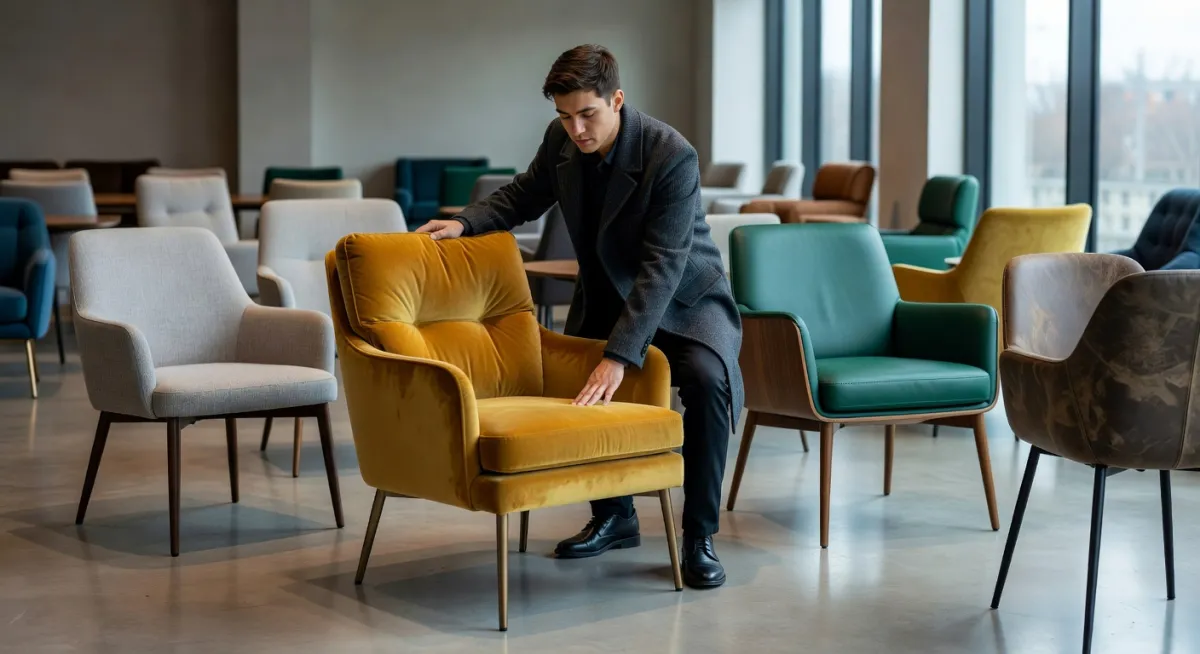
A chair can stop you in your tracks in a showroom. The proportions look right, the upholstery is beautiful, the legs have a satisfying solidity. You sit down — and something is off. Your knees ride too high, your lower back searches for support that isn't there, your shoulders creep toward your ears. Within twenty minutes you're shifting, fidgeting, standing up. The chair looked perfect. It just doesn't work.
This gap between appearance and experience comes down to geometry. Every chair embeds a set of angles, distances, and spatial relationships that either cooperate with the human body or fight it. Understanding those relationships is the difference between choosing furniture that genuinely serves you and simply furnishing a room that photographs well.
The Foundation: Seat Height and the 90-Degree Rule
Seat height is the single most consequential dimension in chair design, and it is almost always the first thing a body registers — usually without the sitter consciously noticing why something feels wrong.

As an Amazon Associate, I earn from qualifying purchases.
The guiding principle is straightforward: when you sit with your back against the backrest, your feet should rest flat on the floor with your knees bent at roughly a right angle. This distributes the weight of your thighs along the full length of the seat pan rather than concentrating pressure behind the knees, where major blood vessels and nerves run close to the surface. A seat that is too high leaves the feet dangling, cutting off circulation at the thigh edge. A seat that is too low forces the knees above the hips, tilting the pelvis backward and collapsing the lumbar curve.
The ergonomic standard for a general-purpose task chair typically places the seat between about 16 and 21 inches from the floor — a range intended to accommodate a broad spread of human heights. Dining chairs tend to sit near the lower end of this range to work with standard table heights. Office chairs almost always offer height adjustment precisely because this dimension is so personal and so critical.
Seat Depth: The Overlooked Companion Measurement
Height without depth is only half the story. The seat pan should be deep enough to support most of the thigh but shallow enough that the front edge doesn't press into the back of the knee. As a rough guide, there should be a gap of roughly two to four fingers between the front edge of the seat and the back of the sitter's knee. Seats designed for showroom drama often run very deep, which looks generous and substantial but forces shorter-legged people to either perch at the front edge — losing back support entirely — or slide back and have their circulation compromised.
The Backrest: Angles, Curves, and Lumbar Support
The human spine is not straight. It has a natural S-curve: the lumbar region (lower back) curves inward, the thoracic region (mid-back) curves outward, and the cervical region (neck) curves inward again. A backrest that ignores this shape forces the spine to flatten against a flat surface, which places the intervertebral discs under uneven load and fatigues the muscles that constantly try to restore the natural curve.
As an Amazon Associate, we earn from qualifying purchases.
Good backrest design does two things: it matches or accommodates the natural lumbar curve, and it reclines at an angle that reduces the compressive load on the spine.
The Science of Recline Angle
Sitting fully upright at 90 degrees sounds like the "correct" posture, but research into spinal disc pressure has consistently shown that a slightly reclined angle — somewhere around 100 to 110 degrees between the seat and the backrest — reduces the load on lumbar discs compared with sitting bolt upright. This is why well-designed task chairs offer a gentle backward tilt, and why lounge chairs and recliners are so immediately restful: at a greater recline, the weight of the torso transfers increasingly to the backrest rather than being borne entirely by the spinal column and its supporting muscles.
The implication for choosing a chair is significant. A dining chair with a perfectly vertical back may look architecturally precise, but extended sitting at that angle accumulates fatigue. A reading chair or armchair with a backrest angled between 100 and 115 degrees can feel dramatically more comfortable for the same duration of use.
Where the Lumbar Support Lands
The lumbar curve typically sits between the bottom of the ribcage and the top of the pelvis — roughly at the level of the navel when seated. A backrest that provides its deepest inward curve at this point will feel supportive. One that bulges at mid-back height pushes the upper body forward while leaving the lower back unsupported. Many inexpensive chairs place cosmetic lumbar features too high, which is why they look ergonomic in a catalogue but feel uncomfortable within the hour.
The Seat Angle: Flat Is Not Neutral
Most people assume a level seat pan is the neutral starting point. In practice, a slight downward tilt toward the front — even just two or three degrees — encourages the pelvis to tilt forward naturally, which in turn preserves the lumbar curve without conscious effort. This is the principle behind saddle chairs and forward-tilting ergonomic stools, taken to an extreme. In conventional seating, a modest forward slope has the same effect in miniature.
Conversely, a seat that slopes backward pushes the pelvis into a posterior tilt, which flattens the lumbar curve and rounds the lower back — precisely the posture that loads the lumbar discs unevenly. Many soft, heavily padded chairs sink in the centre and create exactly this unintended backward slope as they age and compress.
Armrests: Support or Obstacle?
Armrests are perhaps the most misunderstood component of chair geometry. Their purpose is to support the weight of the forearms, which reduces the load on the neck and shoulder muscles — a meaningful benefit during extended sitting. But armrest height is critical. If they sit too high, the shoulders are forced upward into a constant shrug. Too low, and the sitter leans sideways to reach them, introducing lateral stress into the spine.
The correct height positions the forearm roughly parallel to the floor, with the elbow bent at approximately 90 degrees and the shoulder relaxed. For task chairs, this is typically around 7 to 10 inches above the compressed seat surface, though this varies with individual proportions.
Armrest width — the distance between the two arms — also matters. Arms set too wide force the elbows out, stressing the shoulder joints. Too narrow, and they interfere with natural movement. For dining chairs and side chairs, absent armrests are sometimes the right answer: they allow the chair to tuck under the table properly and don't constrain movement during a meal.
How Intended Use Reshapes All of These Principles
There is no single universally correct set of chair dimensions because the ideal geometry shifts with the activity the chair supports.
Task and Dining Chairs
For seated work — writing, eating, using a keyboard — a relatively upright posture is appropriate because the task is in front of the body. Seat height relative to the work surface matters as much as the chair geometry itself. A dining chair designed to pair with a standard-height table works within a tightly constrained set of dimensions that simply don't apply to a lounge chair intended for reading or conversation.
Lounge and Leisure Seating
When the purpose is rest and relaxation, the geometry shifts substantially. The backrest angle increases. The seat height can be lower because ease of entry matters less than sustained comfort. Armrests become more important as a resting surface rather than a posture support. The whole chair may tilt back as a unit, orienting the body toward a screen or a view rather than toward a table surface.
Occasional and Accent Chairs
Some chairs are genuinely occasional — used for brief periods, chosen as much for visual contribution to a room as for ergonomic performance. A sculptural accent chair that will see fifteen minutes of use at a time can afford to prioritise form. The problem arises when these same choices are made for chairs that end up bearing the weight of hours of daily use.
Reading a Chair's Geometry Before You Sit
Once you know what to look for, you can begin to assess a chair's ergonomic intent before you even sit down.
- Measure seat height. Bring a tape measure. Compare it against your own lower-leg length from heel to the back of the knee.
- Check the seat depth. Sit back fully. Can you fit two to four fingers between the seat edge and the back of your knee?
- Feel for the lumbar curve. Press your lower back into the backrest. Does it make contact at your lumbar region specifically, or does the chair touch only your mid-back and tailbone?
- Assess the recline angle. Does the backrest angle feel like it permits a relaxed posture, or does it force you upright regardless of your preference?
- Test armrest height. With your shoulders completely relaxed, do the armrests support your forearms without pushing your shoulders up?
- Sit for longer than feels necessary. The deficiencies of bad chair geometry rarely announce themselves in the first two minutes. Give it ten.
Why Manufacturers Sometimes Get It Wrong
The economic and aesthetic pressures of furniture design push in directions that aren't always ergonomically neutral. Low seat heights look sleek and contemporary. Very deep seat cushions read as luxurious. Dramatic backrest angles photograph beautifully. Armrests at showroom-flattering heights look substantial. None of these defaults are inherently wrong — but they need to be checked against the actual geometry that the human body requires.
Materials compound the challenge. A chair that measures correctly in its factory configuration may perform differently after a year of use, as foam compresses, springs settle, and fabric stretches. The effective seat height drops. The apparent lumbar support disappears into the cushion. This degradation is predictable, which is why the density and quality of internal materials matters alongside the visible geometry.
The Geometry Is the Comfort
Ultimately, a chair's comfort is not a quality that gets added on top of its design. It is encoded in the design itself — in the precise distances and angles that determine how the chair relates to the body placed in it. Beautiful materials and refined finishing can make a well-proportioned chair a pleasure. They cannot rescue a chair whose geometry is wrong for the bodies that use it.
The most useful shift in perspective for anyone choosing seating is to stop treating comfort as a subjective impression gathered in a brief showroom test and start treating it as a set of measurable relationships between a chair's dimensions and your own body. When those relationships are right, comfort follows almost automatically. When they're wrong, no amount of beautiful upholstery will make the difference.