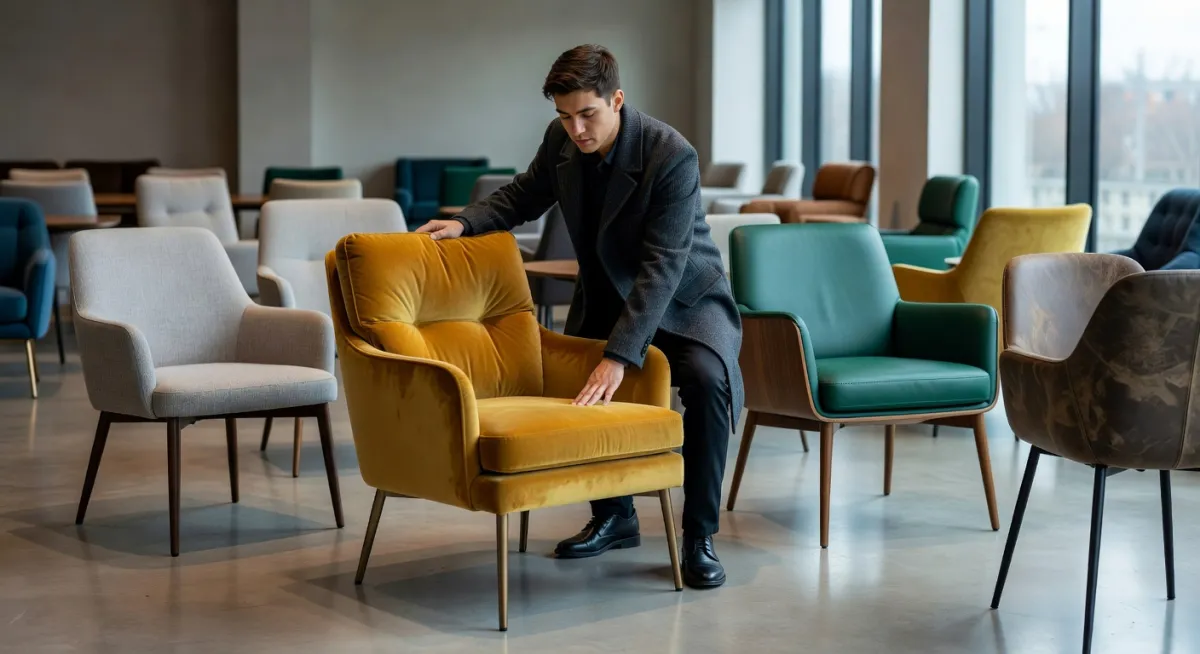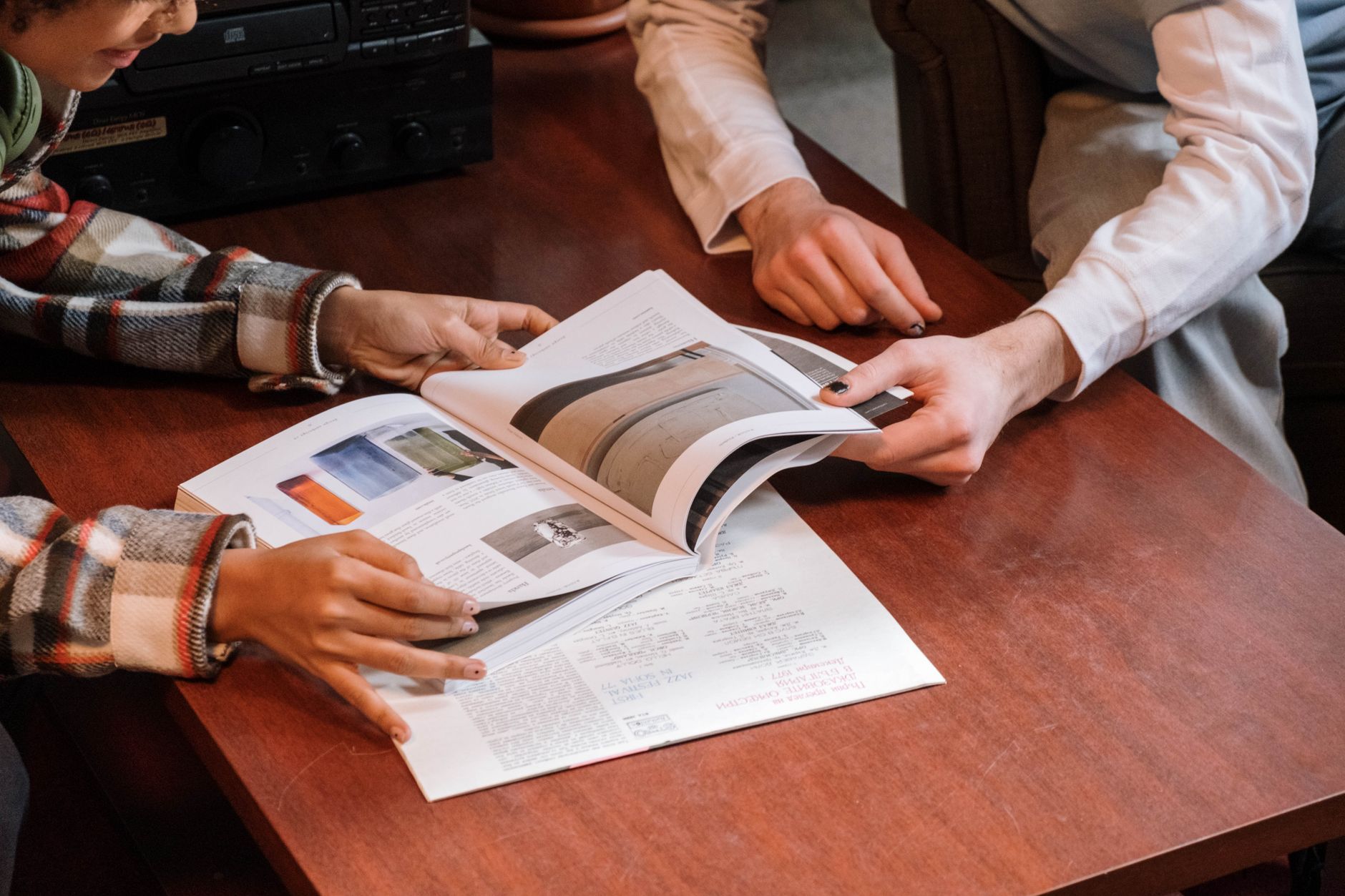
Most people choosing upholstered furniture spend their time weighing colour and texture — and those things matter. But the decisions that determine whether a sofa still looks good in ten years, or starts pilling and sagging in two, happen at a much deeper level: inside the fabric itself, in the way threads are spun, interlaced, finished, and cut. Upholstery fabric construction is, in the truest sense, a design material in its own right — and understanding it changes how you read every piece of furniture you encounter.
The Basics: How Weave Structure Creates Character
All woven upholstery fabrics are built from two sets of threads locked together at right angles. The warp threads run lengthwise along the loom and are held under tension throughout weaving. The weft threads pass horizontally across them. How those two sets of threads interlace — how often they cross, how long each thread floats on the surface before being anchored — determines the fabric's visual texture, surface sheen, and mechanical behaviour.
A plain weave interlaces warp and weft at every single crossing point. The result is a tight, stable structure that resists distortion and is relatively easy to clean. It's one of the most common constructions in workhorses like canvas and many cotton duck fabrics. Not glamorous, but dependable.
As an Amazon Associate, I earn from qualifying purchases.
A twill weave introduces a diagonal pattern by having each weft thread skip over two or more warp threads before interlacing, offset by one thread on each successive row. This creates the characteristic diagonal rib you see in denim and herringbone. In upholstery, twill constructions tend to be more pliable than plain weaves and drape more naturally around curves — a useful property when fabric is being pulled across the arms and back of a complex frame.
A satin weave takes the concept further, allowing weft (or warp) threads to float across many crossing points before anchoring. The long floats reflect light uniformly and produce the lustrous surface associated with satin and sateen fabrics. The trade-off is mechanical: those long floats are more exposed to abrasion and snagging, which is why high-sheen satin-weave fabrics are better suited to occasional-use furniture than to daily-life upholstery.
Grain Orientation: The Detail Upholsterers Know That Buyers Often Don't
The thread count direction in a woven fabric — warp (lengthwise) versus weft (crosswise) — has different tensile strengths, which is why fabric grain orientation during upholstery cutting affects how the finished piece wears over time. This is not a minor technicality. Warp threads are stretched under loom tension during weaving, which tends to make them stronger and more resistant to stretching in use. A skilled upholsterer aligns the stronger warp direction with the areas of highest stress on the piece — typically the seat and back, where tension is repeatedly applied and released every time someone sits down and stands up.
When fabric is cut off-grain to save material or to match a pattern repeat in the wrong direction, the weaker weft threads bear load they weren't structurally suited for. The fabric distorts faster, seams pull unevenly, and patterns that looked centred on the bolt can shift over time on the furniture. On a sofa or sectional, where you have large unbroken panels of fabric under constant use, grain alignment is one of those invisible quality markers that separates careful construction from careless production.
Complex Weaves: Jacquard, Damask, and Brocade
For much of weaving history, complex patterned fabrics required extraordinary manual skill — a separate worker manually lifting individual warp threads to allow the pattern weft to pass through in the right sequence. The industrial revolution of patterned textiles came in a single invention.
Jacquard looms, invented by Joseph Marie Jacquard in 1804, use a punch-card system to control individual warp threads, enabling the complex woven patterns seen in damask and brocade upholstery fabrics. The significance is hard to overstate. Before Jacquard's mechanism, an intricate damask pattern required two people to weave: one to operate the loom, one to manually control the heddles. The punch-card system automated that second role entirely, making complex patterned cloth far more accessible and consistent.
In a damask, the pattern is created by contrasting weave structures within the same set of threads — typically a satin-weave figure on a twill or sateen ground, using a single colour of yarn. The motif appears because the two weave structures reflect light differently. Run your hand across a damask and the pattern seems to shift as it moves in and out of light — that's not a trick of dye, it's a trick of structure.
Brocade takes a different approach, introducing supplementary weft threads in additional colours to literally build up a raised pattern. Those supplementary threads float across the back of the fabric where they aren't needed, which is why the reverse of a brocade often looks like a tangle of loose threads. That floating also means brocade requires some care in upholstery — the supplementary yarns can snag if the fabric is abraded, and the raised surface, beautiful as it is, sits proud of the base cloth in a way that concentrates wear.
Pile Fabrics: Structure That Goes in a Third Dimension
Most woven fabrics are essentially two-dimensional structures. Pile fabrics break that rule by raising loops or cut fibres above the base cloth to create a three-dimensional surface — and the method by which that pile is made has direct consequences for durability and behaviour.
Velvet is the most storied pile fabric in upholstery history. Velvet's distinctive pile is created by weaving two fabric layers simultaneously connected by pile threads, which are then cut apart — a technique with roots in 14th-century Italian textile production in cities like Genoa and Venice. The cut pile is what creates velvet's characteristic softness and the directionality that makes it appear different shades from different angles — that visual quality, called shading, is actually the pile lying in slightly different directions catching light differently. It's a structural phenomenon, not a colour variation.
What this means in practice: velvet is sensitive to compression and directional pressure. A heavy object left on a velvet cushion can flatten and mat the pile. But — and this is the useful part — velvet pile can often be revived with steam and gentle brushing, because you're not removing material, just repositioning it. Understanding the structure makes the maintenance obvious.
Corduroy uses a related principle — a cut weft pile — but the pile threads are arranged in parallel ridges (wales) rather than uniformly across the surface. The wale count (how many ridges per inch) determines the fabric's character: wide-wale corduroy has a bold texture and relatively robust ridges; fine-wale sits closer to velvet in feel and visual subtlety.
Bouclé achieves its looped, textural surface differently — through the yarn itself rather than a separate pile construction. The yarn is spun with loops deliberately incorporated into its structure. This creates a surface that is visually rich and tactilely interesting but requires attention during upholstery: the loops can snag on sharp objects, and the irregular yarn surface holds onto pet hair and debris in a way that plain-weave fabrics do not.
How Durability Is Measured — and What the Numbers Mean
Fabric durability for upholstery is most commonly expressed through abrasion testing: a standardised process in which a fabric sample is subjected to repeated rubbing until it shows measurable wear, and the number of cycles endured before that point is recorded. The two dominant testing standards divide broadly along geographic lines.
The Wyzenbeek test, more common in North American specifications, uses a back-and-forth rubbing motion with a wire mesh or cotton duck abradant. Results are expressed in double rubs. General domestic use is typically specified at 15,000 double rubs or above; heavy domestic or light commercial use at 30,000 or more; heavy commercial applications at 100,000 and beyond.
The Martindale abrasion test, the European equivalent of the Wyzenbeek method, uses a figure-eight rubbing motion and is the standard specified by most UK and European furniture manufacturers for upholstery durability rating. The figure-eight motion is considered more representative of real-world multi-directional wear than a simple back-and-forth action. Martindale ratings for domestic upholstery typically start around 15,000 cycles; the threshold for heavy domestic or light contract use is generally placed around 25,000–30,000 cycles; contract-grade specifications often require 40,000 cycles or more.
Two important caveats about these numbers: first, the tests measure abrasion specifically — they don't predict performance against UV fading, moisture, pilling, or seam stress. Second, the correlation between a test result on a flat fabric sample and real-world performance on a three-dimensional upholstered piece is imperfect, because the geometry of actual furniture creates stress concentrations that the flat test doesn't replicate. The numbers are a useful guide, not a guarantee.
Finishing: What Happens to Fabric After It Leaves the Loom
Weaving produces what the industry calls greige goods — raw, unfinished fabric. Everything that happens after that, from dyeing to chemical treatment, is finishing, and it can modify the fabric's performance dramatically.
Calendering passes fabric between heated rollers under pressure, compacting the structure and creating a smoother, sometimes glossy surface. It's essentially the textile equivalent of ironing taken to an industrial extreme, and it can improve a fabric's resistance to surface soiling by closing up the spaces between threads.
Scotchgard and similar fluorochemical treatments apply a surface coating that reduces the surface energy of the fabric — making liquids bead rather than spread. These are effective but have a lifespan: they wear away with use and cleaning, and the protection needs to be reapplied. They also sit on top of the fibre rather than within it, which means abrasion gradually removes the coating from the areas of highest wear — exactly where you need protection most.
A fundamentally different approach underlies some performance fabrics. Crypton fabric, developed in the 1990s, achieves stain and moisture resistance through a process of embedding a polymer barrier within each individual fiber rather than applying a surface coating. Because the barrier is within the fibre structure rather than sitting on top of it, it doesn't wear away in the same manner. This distinction — between surface treatment and structural modification — is a useful lens for evaluating any fabric marketed as stain-resistant.
Flame-retardant finishing is another category of chemical treatment that varies significantly in its approach and implications. Some treatments are applied topically; others are incorporated into the fibre chemistry at the spinning stage. In many countries, upholstery fabrics used in contract and public environments are required to meet specific ignition resistance standards, so flame-retardant treatment is a compliance consideration as much as a performance one.
Yarn and Fibre: The Starting Point for Everything
Weave structure and finishing both operate on top of the fundamental properties of the yarns themselves. The fibre content — what the yarn is made of — sets the ceiling for what any fabric can achieve.
Wool is naturally resilient, meaning it springs back after compression rather than deforming permanently. It has a scaly fibre surface that helps it resist soiling (dirt sits on the surface rather than penetrating deeply) and it is naturally flame-resistant. The trade-offs are sensitivity to moisture and shrinkage, vulnerability to moths, and a price point that reflects its agricultural origins.
Linen is strong — stronger than cotton — and gets stronger still when wet. Its fibre is naturally hollow and breathes well, which makes it comfortable in warm conditions. The downside relevant to upholstery is that it wrinkles and creases readily and softens less with washing than cotton does, which means a tight linen upholstery can look worn relatively quickly even if it isn't structurally compromised.
Polyester and nylon, the dominant synthetic options, offer high abrasion resistance, good colourfastness, and resistance to moisture. Solution-dyed polyester — where the colour is incorporated into the fibre before extrusion rather than applied to its surface — is particularly resistant to UV fading, which is why it dominates outdoor upholstery for garden furniture and lounge sets. The weaknesses of synthetics are primarily tactile and aesthetic: they can feel less natural, some types pill more readily than natural fibres, and they tend to build up static charge.
Blends are often the most practical answer — a linen-cotton blend captures some of the strength and breathability of linen with the softer hand and easier maintenance of cotton; a wool-nylon blend retains wool's resilience while improving its abrasion resistance where the fibres meet.
Reading Construction as a Design Choice
All of this technical knowledge ultimately serves a practical purpose: understanding what a fabric is doing, not just what it looks like. A tight plain-weave cotton says something specific — it will perform consistently, age predictably, and take cleaning without drama. A cut-pile velvet says something different — it will look extraordinary under raking light and reward careful handling, but it demands more of its owner. A heavily treated performance fabric says something different again — it is engineering first, aesthetics second, a choice made with children or heavy daily use in mind.
Construction is not separate from design; it is design made physical. The weight a fabric has when you lift it, the way it falls across a frame, the sound it makes under friction, the way its surface catches or diffuses light — these are all expressions of structural decisions made in the mill. Knowing what those decisions were, and why they were made, gives you a far more accurate picture of what a piece of furniture will be in your home five years from now than any amount of time spent looking at colour swatches alone.
Sources
Every factual claim in this article was independently verified against the following sources:
- Jacquard loom | Definition, HIstory, Computer, & Facts | Britannica — britannica.com
- What Is Crypton Fabric And Why Atlanta's Top Designers Swear By It — lsfabrics.com
- Warp and Weft: Thread Count (EPI + PPI), 3 Weave Types & Fabric Guide | Apex Fashion Lab | Apex Fashion Lab — apexfashionlab.com
- How Is Velvet Fabric Made: A Comprehensive Guide To The Luxurious Textile — northshorecrafts.com
- Upholstery Fabric Rub Tests Explained | American Leather — americanleather.com