Run your hand along the corner of a well-made chest of drawers and you might feel a subtle ripple — a series of interlocking teeth that suggest something deliberate, almost obsessive, went into its construction. That's a dovetail joint, and it tells you more about the piece's quality than any finish or hardware ever could. The joint — the invisible or barely visible point where two pieces of wood meet — is where furniture lives or dies. It bears every load, absorbs every seasonal shift in the wood, and outlasts every surface treatment. Understanding joinery is understanding furniture itself.
Why Joints Matter More Than You Think
Wood is a living material, even after it's been cut and shaped. It expands and contracts with humidity, moves along the grain, and responds to decades of use. A joint is an engineered solution to a fundamentally dynamic problem: how do you make two pieces of this restless material hold together reliably, under stress, for generations?
The answer changed dramatically depending on the tools available, the traditions of the workshop, and the design philosophy of the era. Each solution left its mark — sometimes literally visible in the finished piece — and those marks became the signatures of entire craft traditions and design movements.
The Foundations: What Every Wood Joint Must Do
Before diving into specific techniques, it helps to understand the forces a joint must resist. Woodworkers think in terms of racking (the twisting or parallelogram distortion that happens when a chair is pushed sideways), tensile stress (the pulling apart of two joined surfaces), and shear (the sliding of one surface against another). A well-chosen joint addresses the specific combination of stresses its location in a piece of furniture will face. A chair rail joint faces entirely different demands than a drawer corner or a tabletop breadboard end.
The Dovetail: Geometry as Strength
No joint has a stronger claim to being the furniture maker's ultimate test than the dovetail. Its distinctive fan-shaped tails interlock with corresponding pins in an arrangement that looks almost decorative — and in many pieces, it is intentionally left visible. But its beauty is inseparable from its function.
The dovetail joint's interlocking trapezoidal shape creates mechanical resistance that holds without adhesive, relying on geometry rather than glue for tensile strength. This means that even in the absence of any modern bonding agent, a well-cut dovetail resists being pulled apart in one direction purely because of its shape. The angles of the tails — typically cut at a ratio of 1:6 for hardwoods and 1:8 for softwoods — create a wedging effect that tightens under load rather than failing.
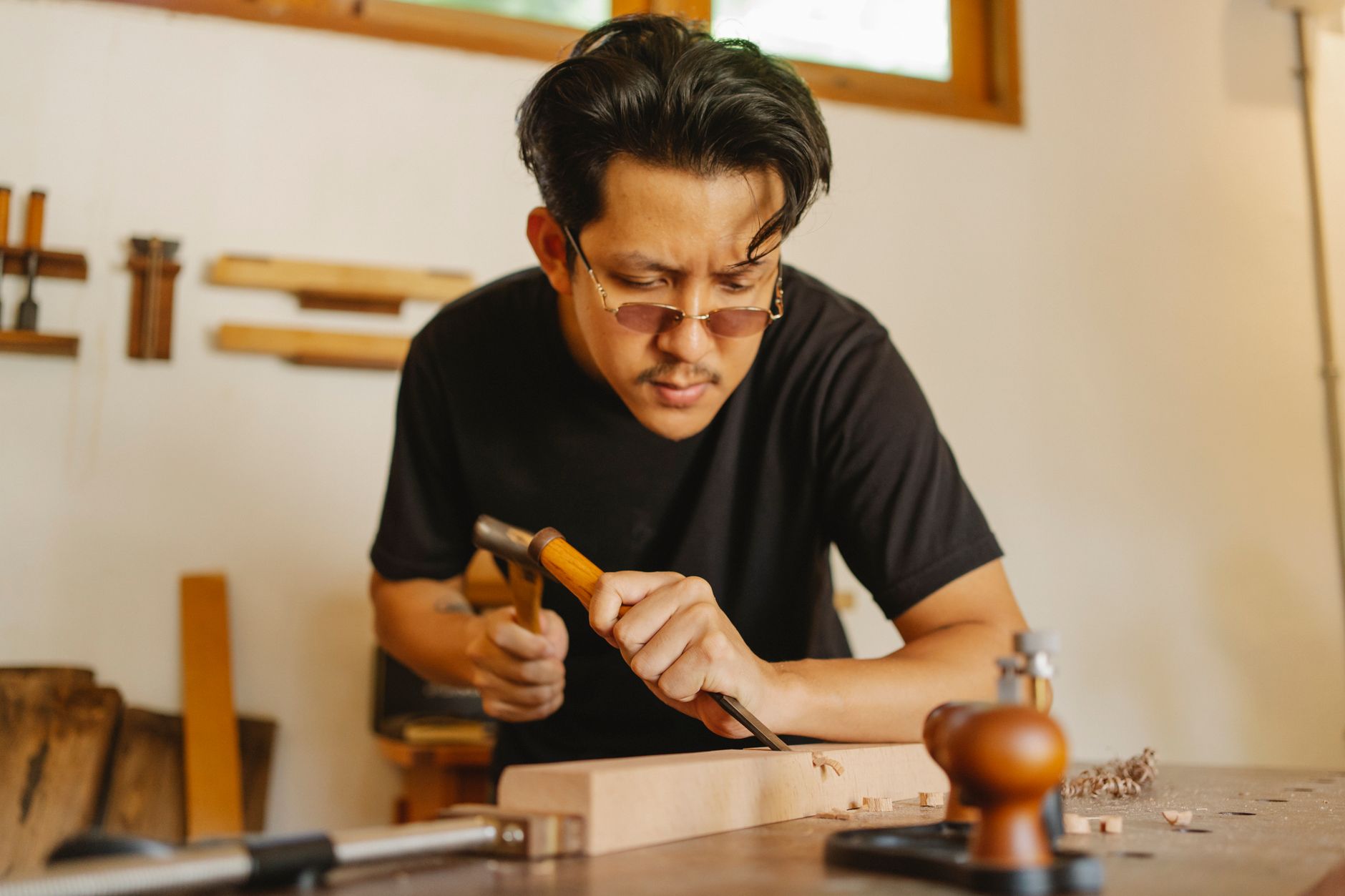
Cutting dovetails by hand requires careful layout, precise sawing, and meticulous chiseling. The gap between a tail and its pin should be unmeasurable — the fit achieved by feel and the finest paring cuts. This is why the joint became a benchmark: it demands accumulated skill, good tools, and patience. A machine-cut dovetail can replicate the form, but the small irregularities of a hand-cut version — each tail slightly different from the last — are the hallmarks craftspeople and serious collectors look for.
Historically, the dovetail appears prominently in 18th-century English and American case furniture. The drawer construction of a Georgian chest reveals it immediately: open a drawer and look at the front corners. Fine period furniture shows hand-cut dovetails with closely spaced tails; the ratio and spacing tell a trained eye roughly when and where a piece was made.
The Mortise and Tenon: The Ancient Workhorse
If the dovetail is the showpiece, the mortise and tenon is the backbone. It is one of the oldest joinery techniques in the world, found in ancient Egyptian furniture, medieval European construction, and contemporary studio pieces alike. The principle is simple: a projecting tongue (the tenon) fits precisely into a corresponding slot (the mortise) cut into the receiving piece.
What makes the mortise and tenon so enduring is its versatility. By varying the proportions, adding wedges, cutting the tenon at an angle, or using drawboring (where a slightly offset wooden pin is driven through both pieces to pull them into tight contact), the joint can be tuned for an enormous range of applications. Chair legs meet seat rails with mortise and tenon joints. Table aprons attach to legs the same way. Frame-and-panel door construction — the technique that allows large flat surfaces to move without cracking — depends on mortise and tenon at every corner.
The Arts and Crafts movement of the late 19th and early 20th centuries made the mortise and tenon not just structurally central but visually central. Gustav Stickley and his contemporaries celebrated the joint by exposing it — letting the through-tenon protrude visibly beyond the surface of a leg, sometimes pinned with a contrasting wooden wedge. This was a deliberate aesthetic and philosophical statement: honest construction should be seen, not hidden. The joint became the style.
Box Joints and Finger Joints: Industrial Honesty
The box joint (also called the finger joint) is the rectilinear cousin of the dovetail. Where dovetails use angled tails, box joints use a series of square interlocking fingers of equal width. They lack the mechanical locking of the dovetail — they require adhesive to stay together under tension — but they offer a large gluing surface area, which creates a strong bond in shear. They are also far more amenable to machine cutting.
This relationship to machinery made box joints emblematic of a different era. As furniture production industrialized in the late 19th and 20th centuries, the box joint became a sign of the factory workshop. Interestingly, craftspeople working in the Arts and Crafts tradition reclaimed it as a visible decorative element, playing on its geometric regularity. In mid-century Scandinavian design, the clean repetition of finger joints aligned perfectly with an aesthetic that valued functional pattern over ornament.
Bridle Joints and Halving Joints: The Underrated Middle Ground
Not every joint needs to be invisible or celebrated. The bridle joint — where a slot cut into one piece receives a tongue projecting from another, usually at a corner or T-junction — is often found in chair and bench construction. It provides good resistance to racking and is considerably easier to cut than a full mortise and tenon while offering similar structural logic.
Halving joints, where each piece loses half its thickness so they sit flush when crossed, are common in frame construction. They appear in early European furniture, in Japanese tansu cabinetry, and in mid-century modern pieces where the designer wanted the surface to read as continuous even where structural members intersect. The joint itself disappears into the geometry of the design.
Japanese Joinery: The Art Form as Engineering
No discussion of furniture joinery is complete without acknowledging the extraordinary tradition of Japanese woodworking, which elevated the joint to something approaching philosophy. Japanese temple and furniture construction developed an array of joints of remarkable complexity — not as ornamentation, but as engineering solutions to specific structural and material challenges, often in the complete absence of metal fasteners.
Joints like the kigumi interlocking systems used in architectural timberwork, or the delicate interlocking joints found in traditional tansu chests, depend on three-dimensional geometry so complex that they can be assembled and disassembled without glue. The precision required means that the joint is both its own fastener and its own insurance against movement — a piece of wood that fits perfectly has nowhere to go.
This tradition influenced Western studio furniture making significantly during the latter half of the 20th century, as craftspeople like James Krenov and Sam Maloof sought a more contemplative approach to the craft. The idea that a joint could be a solution arrived at through deep understanding of wood's nature — rather than brute mechanical force — became central to the studio furniture movement.
Knock-Down and Modern Joinery: Function Without Permanence
The 20th century introduced a new requirement that traditional joinery hadn't needed to address: furniture that could be shipped flat and assembled by the end user, or disassembled and moved. This drove the development of knock-down (KD) fittings — metal cam locks, bolt-and-barrel connectors, and the now-ubiquitous system of dowels and cam locks associated with flat-pack furniture.
These systems are genuinely clever engineering, but they represent a fundamental shift in joinery philosophy. Traditional joints work with wood — they account for its movement, use its properties of expansion and contraction, and are made from the same material they join. KD fittings work against wood's tendency to move, relying on metal precision and tight tolerances. The result is furniture that is structurally adequate when new but often fails gracefully — that is, it loosens rather than breaks, and the loosening is the beginning of the end.
This distinction matters because it explains what you're paying for in furniture. A mortise and tenon joint, well made and properly glued, can be stronger than the wood around it. A cam-lock fitting is only as strong as the particleboard it threads into.
Reading Furniture Through Its Joints
Once you know what to look for, joints become a key to understanding a piece of furniture's quality, age, and origin. Look at the back corners of drawers: hand-cut dovetails with varying spacing and slight irregularity suggest pre-industrial or studio craft; perfectly even machine-cut dovetails indicate 20th century or later production; dowels instead of dovetails suggest cost-cutting. Examine the legs of a chair at the seat rail: a clean, tight-fitting joint that shows no gap after years of use indicates good proportions and good gluing; a joint that wobbles has either failed or was never well made.
Exposed through-tenons on a side table or bench are a design declaration — they announce that the maker wanted you to see how it was built. Invisible joinery, achieved with equal skill, makes the opposite statement: that the maker's confidence required no evidence.
The Skill Hiding in Plain Sight
A beautifully finished surface is easy to appreciate; perfect joinery takes knowledge to recognize. But the joint is where a furniture maker's judgment, patience, and command of the material are truly tested. Anyone can sand wood smooth. The ability to cut a tail that fits its pin without a sliver of daylight, or to cut a mortise so precisely that the tenon requires careful hand pressure to seat fully, represents years of practice — practice in understanding how wood moves, how chisels behave at the end of a stroke, and how tight is tight enough without being too tight.
Design movements have always understood this intuitively. When the Arts and Crafts reformers exposed their joinery, they were insisting that honest construction was itself beautiful. When Japanese craftspeople spent weeks on a single complex joint, they were demonstrating that the meeting of two pieces of wood was worthy of the same contemplation as any other art form. The joint is the furniture maker's signature — and once you learn to read it, every piece of furniture has something to say.
Sources
Every factual claim in this article was independently verified against the following sources:
- Dovetailing Techniques for Stronger Constructs (Joinery Basics) — toolsradar.com