You've arranged your living room a dozen times, and something still feels off. The sofa looks too bulky, the chairs seem to float, or the whole space feels vaguely unsettled — like furniture placed in a room rather than designed for it. The frustrating truth is that you're probably not making taste mistakes. You're running into physics: the visual physics of scale, proportion, and weight. Once you understand these three principles, what felt like mysterious instinct becomes a repeatable, learnable skill.
What Scale, Proportion, and Visual Weight Actually Mean
These three terms get used interchangeably, but they describe distinct things. Getting them straight is the first step to diagnosing — and fixing — a room that doesn't work.
Scale: How Big Is It, Really?
Scale refers to the size of an object in relation to the space it occupies. A sofa that fits comfortably in a showroom can feel overwhelming in a smaller living room not because it's badly designed, but because the scale relationship between the piece and the room has changed. Scale is always relational. There is no universally 'large' piece of furniture — only furniture that is large or small relative to a given space.
As an Amazon Associate, I earn from qualifying purchases.
When people say a room feels 'cramped' or 'empty,' they're usually describing a scale problem. Furniture that's too large for a room competes with the architecture; furniture that's too small gets swallowed by it.
Proportion: The Relationships Between Pieces
Proportion is about the size relationships within a furniture grouping. If your sofa is 2.8 metres wide and your coffee table is 60 centimetres long, the proportion is off — not because either piece is wrong on its own, but because they don't relate well to each other. Proportion is the internal logic of a lounge set as a composition.
Classical design borrowed the idea of harmonious proportion from architecture, where relationships between parts — the height of a column relative to its base, the width of a door relative to a wall — were governed by ratios. You don't need to calculate ratios consciously, but you can train your eye to spot when proportions feel harmonious or awkward.
Visual Weight: What Your Eye Perceives as Heavy
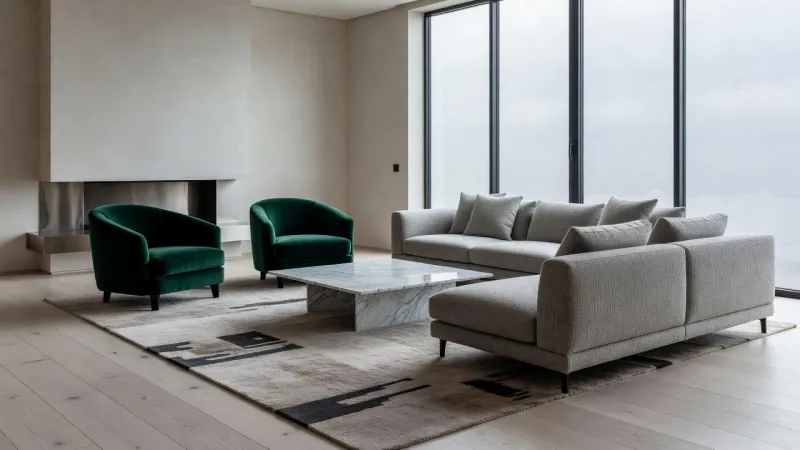
Visual weight is perhaps the most nuanced concept. It refers to how heavy or substantial a piece looks, regardless of its physical mass. A low, wide armchair upholstered in dark velvet will read as heavier than a tall, slender chair in a light linen — even if the actual weights are similar. Visual weight is influenced by colour, texture, density of form, and how much negative space surrounds a piece.
As an Amazon Associate, we earn from qualifying purchases.
Designers balance visual weight across a room the way a photographer balances a composition: not by making everything equal, but by distributing mass so no single area dominates without purpose.
Why Most Lounge Arrangements Go Wrong
The most common mistake is choosing furniture in isolation — falling in love with a sofa in a showroom, then an armchair in another, then a coffee table online — without considering how they'll read together in your specific room. Each piece may be well-designed; the composition fails because no one considered the relationships.
The Floating Furniture Problem
When furniture is pushed against walls, pieces lose their relationship to each other. The room may look 'tidier,' but the lounge grouping loses coherence. Design professionals almost always pull seating away from walls to create a conversation zone — a defined cluster where scale and proportion can work together. Floating furniture in the centre of a room (or slightly away from walls) allows the pieces to relate to each other rather than to the perimeter.
The Mismatched Heights Trap
Rooms feel chaotic when every piece of furniture sits at a dramatically different height with no visual rhythm. A general guideline is that the top of your sofa back, armchair back, and any side tables should create a flowing line — not a jagged skyline. This doesn't mean everything must be the same height, but abrupt transitions without deliberate intent create visual noise.
Ignoring the Rug as an Anchor
One of the most consistent scale errors in lounge rooms is an undersized rug. A rug that's too small acts like an island that furniture hovers around rather than an anchor that holds a grouping together. At minimum, the front legs of all major seating pieces should sit on the rug; ideally, all legs do. This single adjustment can transform the perceived coherence of a room dramatically.
Practical Principles Designers Actually Use
The Two-Thirds Rule for Coffee Tables
A reliable starting point for coffee tables is that the table should be roughly two-thirds the length of the sofa it sits in front of. This proportion feels balanced without making the table look like an afterthought or an obstacle. Height matters too: a coffee table that sits at the same height as sofa seat cushions (roughly 40–45 cm) is generally easier to use and better proportioned than one that sits significantly lower or higher.
The 60-30-10 Colour Rule and Visual Weight
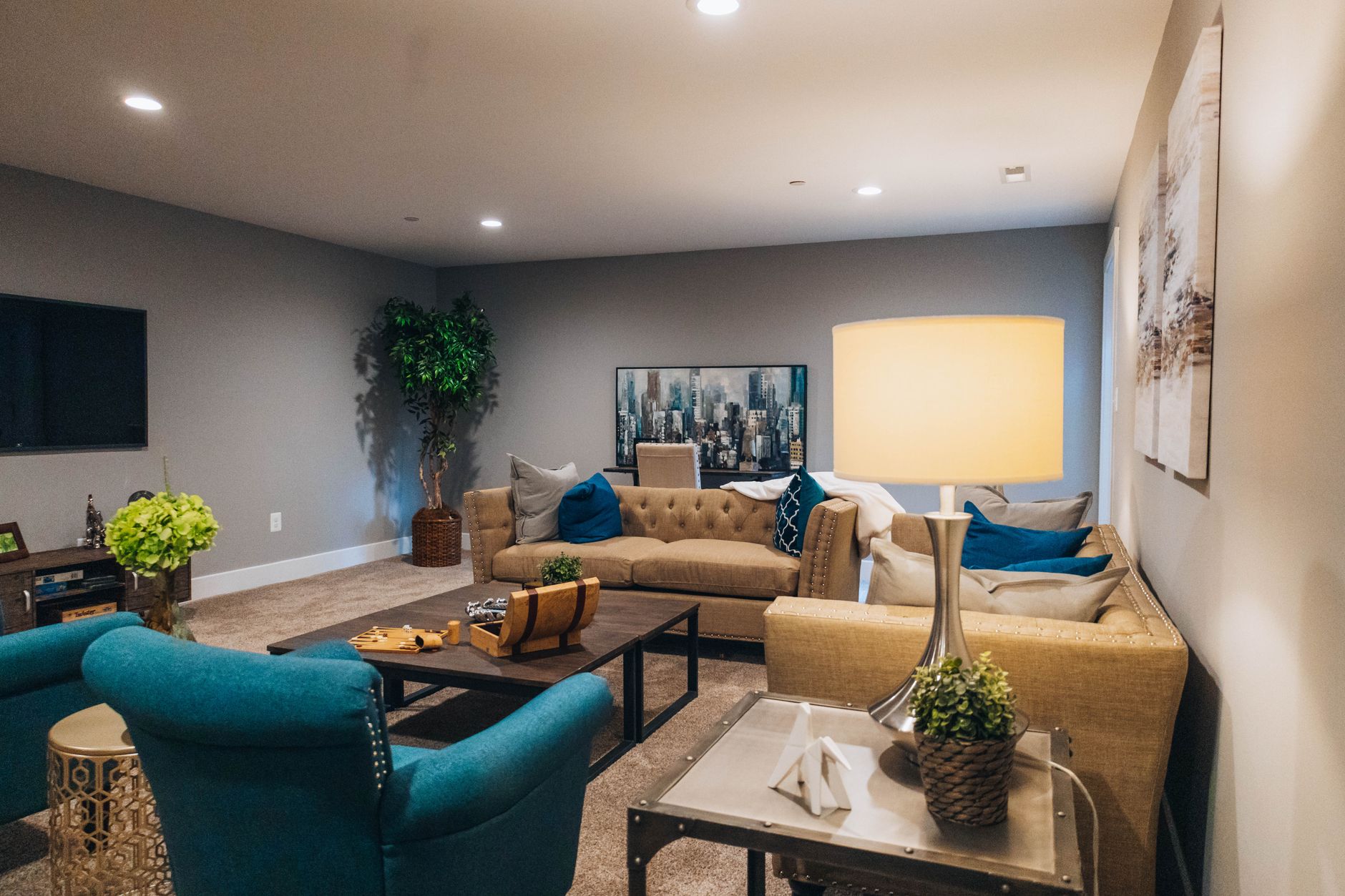
Interior designers often distribute colour using a rough 60-30-10 split: 60% dominant colour (usually walls and large upholstery), 30% secondary colour (accent chairs, rugs), and 10% accent (cushions, decorative objects). This isn't just about aesthetics — it directly manages visual weight distribution. A room where everything competes equally for attention has no focal point, which your eye reads as unsettled.
Anchoring With a Focal Point
Every successful lounge arrangement has a focal point — a fireplace, a feature wall, a significant piece of art, or a television — and the furniture is arranged in relation to it. The focal point is the heaviest visual element in the room, and the seating arrangement should acknowledge it. Furniture that's arranged without reference to a focal point tends to feel directionless.
Balancing Visual Weight Asymmetrically
Symmetry is the easiest way to achieve balance — matching armchairs flanking a sofa, identical side tables on either end — but it isn't the only way, and it can feel rigid. Asymmetrical balance is more challenging but often feels more alive: a large, visually heavy armchair on one side balanced by two lighter chairs and a floor lamp on the other. The total visual mass on each side of the room should feel roughly equivalent, even if the elements creating it are different.
How to Audit Your Own Room
The Squint Test
Stand at the entrance to your room and squint slightly, blurring your vision. This strips away detail and lets you see the broad distribution of visual mass. Areas that appear darker and denser are visually heavy; lighter, emptier areas are visually light. A well-balanced room will have a roughly even distribution, or a deliberate concentration (a focal point) with lighter surroundings.
Photograph It in Black and White
Colour influences your perception of weight. Taking a black-and-white photo of your arrangement removes colour as a variable and lets you see pure tonal contrast and mass distribution. Designers use this technique to evaluate compositions objectively. If the room looks chaotic or lopsided in black and white, the underlying structure needs work that colour choices can't fix.
The Tape Test Before You Commit
Before moving heavy furniture or purchasing new pieces, use painter's tape on the floor to mark the footprint of potential arrangements. This is one of the most practically useful habits you can develop. It costs nothing and makes scale and proportion relationships immediately visible in your actual space — far more reliably than any online room planner.
Scale Principles Room by Room
Small Rooms
Small rooms tolerate less visual complexity. Fewer pieces with better proportional relationships will outperform more pieces that individually seem appropriate. In a small lounge, one sofa with a single armchair and a well-proportioned coffee table will typically feel more resolved than a full three-piece suite that crowds the floor plan. Leggy furniture — pieces raised off the ground on visible legs — reads as lighter and less dominant, preserving the sense of space.
Large or Open-Plan Rooms
Open-plan spaces create the opposite problem: furniture that would look appropriate in a standard room can look stranded or insignificant. The solution is usually to create distinct zones with larger, more substantial pieces and to use rugs to define each area clearly. Sectional sofas, which carry significant visual mass, often work better in large rooms precisely because they have enough presence to hold the space.
These Are Skills, Not Instincts
The reason some people seem to have 'natural' design ability is mostly that they've absorbed these principles through exposure — to well-designed spaces, to design publications, to professional interiors. The principles themselves aren't mysterious. Visual weight, proportion, and scale are governed by consistent rules that you can study, practice, and apply deliberately.
The squint test, the tape test, the two-thirds rule — none of these require an art school education. What they require is slowing down and looking carefully at your room as a composition rather than as a collection of individual objects. That shift in perspective is available to anyone willing to take it.
Once you understand that a room 'feeling wrong' is usually a diagnosable problem — too much visual weight in one area, a proportion mismatch between anchor pieces, a scale error in the relationship between furniture and space — you stop treating it as a failure of taste and start treating it as a puzzle with a solution. That's exactly how designers approach it.