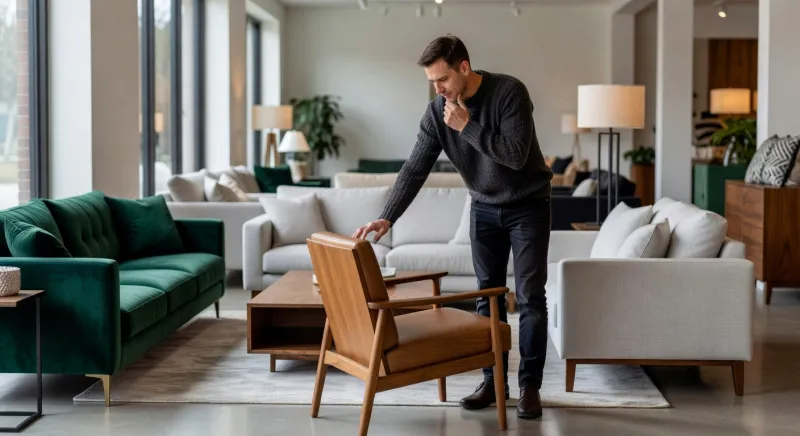
Most people choose a sofa by sitting on it for thirty seconds in a showroom. That test tells you almost nothing useful. What actually determines whether a sofa feels extraordinary in ten years — or sags, squeaks, and embarrasses you in three — is almost entirely invisible: the layered system of frame, webbing, springs, padding, and fabric built up from the inside out. Understanding upholstery construction techniques doesn't require a carpentry degree, but it does change the way you look at every sofa you'll ever consider.
Layer One: The Frame — The Skeleton Everything Else Depends On
A sofa frame is its skeleton. Every other layer is only as reliable as the structure beneath it. The best frames are built from kiln-dried hardwoods — typically beech, oak, or ash. Kiln-drying removes moisture from the timber before construction, which prevents the warping, cracking, and joint failure that occurs when wood dries out naturally after a sofa is already assembled and in use.
Cheaper frames use softwoods, particleboard, or MDF. These materials aren't inherently dishonest — they're legitimate choices for furniture built to a price point — but they carry a real cost in longevity. Particleboard doesn't hold screws or staples well under repeated stress, which means joints loosen faster than they should.
As an Amazon Associate, I earn from qualifying purchases.
How the Joints Are Made Matters as Much as the Wood
Double-dowel and corner-block frame joinery in upholstered furniture frames — where hardwood blocks are glued and screwed at internal corners — is a documented structural reinforcement technique that significantly extends frame life compared to single-staple or butt-joint construction. When you see a frame described as having corner blocks, that's meaningful: those triangular or square blocks of wood glued and fastened into the internal corners of the frame prevent racking — the lateral flex that causes a sofa to wobble and ultimately fail at its joints.
A butt joint, by contrast, is simply two pieces of wood pushed together and fastened. Without reinforcement, it relies almost entirely on the fastener holding under repeated stress — which, over years of use, it often doesn't. If you can lift a sofa and gently twist the frame and feel flex, the joinery is probably minimal.
Layer Two: Webbing — The Foundation Beneath the Springs
Once the frame is built, the seat and back cavities need a supportive base. In traditional upholstery, that base is webbing — interlaced strips of material stretched across the frame opening and tacked or stapled into place. Webbing — historically made from interwoven jute strips tacked to the frame — forms the foundational support layer beneath springs in traditionally built upholstered furniture, and its density and tension directly affect long-term cushion support.
The quality of webbing comes down to two things: the material and the density of the weave. Jute webbing is the traditional benchmark — it's strong, durable, and holds tension well. Rubber webbing (sinuous straps of elastic material) is more commonly used in modern production because it's faster to install. It provides a different, slightly bouncier feel. Neither is categorically better, but jute webbing in a dense grid pattern — strips running both horizontally and vertically, closely spaced — is generally associated with higher-quality traditional construction.
Thin, widely spaced webbing means less support and faster sagging. You can sometimes check this by pressing into the underside of a sofa seat before anything else is assembled on top of it — though in finished furniture, you'll need to rely on descriptions or simply know what questions to ask.
Layer Three: The Spring System — Where Support Character Is Set
Springs sit on top of the webbing (or attach directly to the frame) and define the fundamental feel and resilience of the seat. There are two main systems used in quality upholstery construction.
Eight-Way Hand-Tied Coil Springs
The traditional benchmark for high-quality seating. Individual coil springs — hourglass-shaped, made from tempered steel — are placed in a grid across the seat, each one attached to the webbing below and then tied by hand to its neighbors using twine in eight directions: front, back, left, right, and the four diagonals. This creates a unified spring system that distributes weight evenly and prevents individual springs from bottoming out independently.
Eight-way hand-tying is slow and labor-intensive, which is why it adds significant cost. But it produces a seat that responds fluidly to movement and tends to maintain its support over a very long time, because even when individual springs shift slightly, the tying network redistributes the load.
Sinuous (Serpentine) Springs
These are S-shaped steel wires that run from the front of the frame to the back in parallel rows, clipped into the frame at each end. They're faster to install and can produce a good seat — many well-regarded sofas use them — but the quality of the steel gauge and the clip mechanisms matters a great deal. Heavier gauge wire, more closely spaced rows, and clips that don't allow lateral movement all indicate better construction. Inferior sinuous spring systems tend to develop a creaking, popping sound as the clips loosen, and individual springs can detach from their clips over time.
Layer Four: Padding — Where Comfort Meets Longevity
The padding layers transform a spring system into something you actually want to sit on. This is where upholstery construction gets genuinely complex, because multiple materials are often combined to achieve different qualities at different depths.
Foam
High-density foam is the workhorse of modern upholstery padding. Foam is rated by density (mass per cubic foot) and ILD (Indentation Load Deflection, which measures firmness). Higher density foams resist compression better over time — they don't permanently deform as quickly under repeated use. A sofa that feels identically firm after five years is almost certainly using higher-density foam than one that develops a body-shaped hollow within eighteen months.
The risk with foam alone is that it can feel slightly dead or unresponsive. Many quality pieces layer different density foams — a firmer base layer for support, a softer top layer for immediate comfort — and sometimes combine foam with other materials.
Down and Feather Wrapping
A layer of down or feather-and-down blend wrapped around a foam core gives a seat that distinctive soft, enveloping feeling. It's luxurious, but it comes with a maintenance trade-off: down-wrapped cushions require regular plumping to redistribute the fill and prevent permanent flattening in high-use areas. Cushions that are purely down-filled, without a foam core, are especially high-maintenance — deeply comfortable but quick to lose their shape if neglected.
Dacron and Polyester Batting
A thinner layer of polyester batting is often wrapped around cushion cores to soften edges and create a more rounded, tailored silhouette. It also helps fabric slide smoothly over the cushion for a cleaner appearance. On its own it provides little support, but as a finishing layer over foam or down it's nearly universal in quality upholstery.
Layer Five: The Deck and Inner Construction
Beneath the removable seat cushions lies what upholsterers call the deck — the platform of fabric and additional padding that covers the springs. In a well-built sofa, the deck is itself padded, the fabric is durable, and the whole assembly is neatly finished. In economy construction, the deck is sometimes little more than a thin layer of fabric over barely covered springs.
The back construction follows the same principle. A fully padded back — with webbing or springs in the back frame, followed by padding, followed by the back cushions — gives a piece that remains comfortable and supportive even when you lean against the flat back surface without cushions. A back that feels hollow or hard when leaned against has minimal internal construction.
Layer Six: The Fabric — The Only Part Most People Evaluate
Upholstery fabric is the most visible layer, but evaluating it only by appearance misses the most important qualities. Durability is measured using the double-rub test — a standardized abrasion method that counts how many back-and-forth rub cycles a fabric withstands before showing wear. Fabrics intended for heavy residential use are typically rated above 15,000 double-rubs; commercial or heavy-duty fabrics often exceed 30,000. This number appears on fabric specifications and is one of the most concrete comparisons available.
Weave structure matters separately from fiber content. A tight, dense weave — where individual threads are difficult to separate with a fingernail — holds up far better than a loose weave of the same fiber. Tightly woven fabrics also resist pilling and snagging. Fabric direction matters in pattern matching: a quality upholsterer cuts fabric so patterns align at seams, which wastes more material but produces a finished piece that looks considered rather than assembled from remnants.
How the Fabric Is Attached
On the exterior and underside, fabric is typically pulled taut and stapled or tacked to the frame. The technique here is called pulling — maintaining consistent, even tension as the fabric is secured so that no section is looser or tighter than another. Inconsistent pulling creates visible puckering, wrinkles, or areas where the fabric appears to ripple rather than lie flat. These are visible in finished furniture and indicate either rushed work or inexperienced hands.
Welting — the fabric-covered cord that appears at seams and edges — is another signal of construction quality. Well-applied welting is evenly tensioned, follows straight lines, and sits at the same height throughout its length. Welting that wanders, bubbles, or shows the underlying cord through worn fabric points to shortcuts in application.
What This Means When You're Evaluating a Sofa
Knowing the layers gives you a framework for asking the right questions. Hardwood frame or engineered wood? What joinery method? Eight-way hand-tied, sinuous springs, or no springs at all? What density foam? Is there a down wrap? What's the fabric's double-rub rating? You probably won't get complete answers to all of these — but the willingness of a manufacturer or retailer to answer even some of them is itself informative.
The same layered thinking applies to armchairs and recliners, where the frame-to-fabric construction follows identical principles at a smaller scale. A well-built armchair and a well-built sofa share the same internal logic: every layer built honestly, at the right specification for the intended use.
The furniture that lasts — the pieces that become genuinely useful objects in a home over decades — is almost always the furniture where someone paid attention to what you can't see. The visible surface is the last thing built. Everything underneath it is the reason it's still there.
Sources
Every factual claim in this article was independently verified against the following sources:
- Quality Upholstery Takes Guts — samuelsonfurniture.com
- What Does Corner Blocked Frame Mean? — bestleathercouches.com