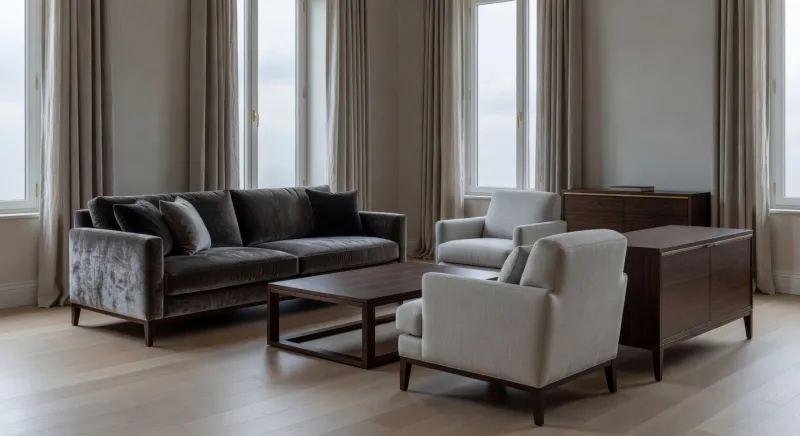
Most people encountering a Hans Wegner chair or an Alvar Aalto stool for the first time assume they're responding to style — that clean silhouette, the warm grain, the absence of fuss. What they're actually responding to is engineering. Scandinavian furniture from the 1940s through the 1960s looks the way it does because of decisions made not at the drawing board but at the workbench: how a piece of wood was steamed and coaxed into a curve, how two pieces were locked together without hiding ugly hardware, how a surface was fed just enough oil to breathe without suffocating under lacquer. The aesthetic was the byproduct. The craft came first.
The Problem Scandinavian Designers Were Actually Solving
To understand what made this movement so technically distinctive, it helps to understand what it was reacting against. Mid-century European furniture — particularly in the Victorian and Baroque traditions still lingering into the early twentieth century — favoured visual complexity: carved ornament, applied mouldings, veneers stretched over weak substrates, upholstery that disguised structural decisions rather than expressing them. The furniture looked rich because it was hiding something.
Scandinavian designers, working in Denmark, Sweden, Finland, and Norway, faced a different set of conditions. Their domestic timber — primarily birch, pine, and beech — grew slowly in cold climates, producing tight, consistent grain that was strong but not easily carved into baroque flourishes. Their craft tradition was rooted in rural joinery, where a joint had to last through generations of use in drafty farmhouses. And they had access, through the design schools and craft guilds that flourished in Copenhagen and Helsinki especially, to a culture that treated the cabinetmaker as an intellectual collaborator rather than a pair of skilled hands.

As an Amazon Associate, I earn from qualifying purchases.
The result was a movement that asked a question most design traditions don't bother with: what is the minimum amount of material and process needed to make something that works perfectly and lasts indefinitely?
Steam Bending: Persuading Wood Rather Than Forcing It
The single most recognisable technical signature of Scandinavian mid-century furniture is the bent wood component — the curved back rail, the gently arcing leg, the seat shell that follows the human spine rather than ignoring it. Achieving these curves without steam bending would require either carving away enormous amounts of solid timber (wasteful and structurally compromised, since curved cuts cross the grain) or laminating thin veneers over a form (the Aalto method, discussed below). Steam bending offered a third path: taking a solid piece of wood and temporarily making it plastic.
The process is deceptively simple in principle. Timber — typically straight-grained stock cut specifically for the purpose — is placed in a steam chest, where exposure to saturated steam at around 100°C softens the lignin that binds the wood fibres together. The window of workability is narrow, often just a few minutes, after which the craftsman bends the piece around a former and clamps it until cooling restores rigidity. Done well, the bent piece is actually stronger in compression on its inner face than the original straight stock, because the fibres have been compressed rather than cut.
What made Scandinavian workshops distinctive wasn't the technique itself — steam bending had been used by Windsor chair makers in England and bentwood furniture manufacturers like Thonet in Austria for over a century — but the precision with which they controlled it. Moisture content in the raw stock was measured carefully, because wood that is too dry will fracture on the outside of the bend while wood that is too wet may not hold its shape. The ratio of bend radius to timber thickness was calculated for each species. And the forms around which pieces were bent were made to exacting tolerances, since any variation in the curve would compound through a chair's geometry and produce a piece that rocked or stressed its joints.
Alvar Aalto and the Revolution of Laminated Bending
If steam bending was the dominant technique for solid components, the Finnish architect and designer Alvar Aalto developed something more radical for structural elements that needed both compound curves and dimensional stability: bent laminated birch. His approach, refined through the late 1920s and commercialised through the furniture company Artek in the 1930s, involved gluing multiple thin layers of birch veneer together over a heated form, so that the adhesive cured while the stack was under tension. The result — which Aalto called the "bent knee" when applied to the junction between a vertical leg and a horizontal seat rail — was a component that was lighter than solid timber, immune to the seasonal movement that causes solid wood to crack joints, and capable of curves that no steam-bent solid section could achieve without fracturing.
The technical insight was that lamination changed wood's relationship to bending stress. In a solid beam, bending creates tension on one face and compression on the other; the fibres at the extremes carry almost all the load. In a laminated stack, each layer is thin enough that the stress differential across it is minimal, and the glue lines — provided they are properly formulated and applied — transfer shear between layers efficiently. You get a structural member that behaves more like a homogeneous material than a natural one.
Aalto's company Artek experimented extensively with the number of laminations, the veneer thickness, and the adhesive formulations needed for different applications. Legs for a low stool demanded different specifications than the cantilevered arm supports of a lounge chair. This iterative, almost scientific approach to what had traditionally been intuitive craft knowledge was characteristic of the broader Scandinavian movement — the sense that understanding why something worked was as important as knowing how to do it.
Joinery: The Hidden Architecture of a Chair
If bending was how Scandinavian designers shaped wood, joinery was how they held it together — and it's in their approach to joints that the movement's philosophy becomes most visible. Traditional furniture joinery in the Western tradition had evolved toward concealment: the mortise-and-tenon joint was buried inside the wood, the dowel was hidden, and where metal hardware was unavoidable it was covered with a decorative cap or plate. The joint was structurally necessary but aesthetically embarrassing.
Danish designers in particular — working in a tradition that ran from Kaare Klint through Hans Wegner, Ole Wanscher, and Børge Mogensen — took the opposite view. A well-made joint was something to show. The wedged through-tenon, where a tenon passes entirely through the mortised member and is locked with a visible wedge, was used not just for its mechanical superiority (the wedge locks the joint in permanent compression) but because it expressed the logic of the construction honestly. You could look at the joint and understand exactly how the chair worked.
Wegner's chairs, in particular, are studies in joint engineering. His 1949 design known simply as "The Chair" — a round-backed armchair that became one of the most studied pieces of furniture of the twentieth century — used a continuous curved back rail that wrapped around to become the armrests, meeting the back legs in a joint that had to handle both the weight of a leaning person and the lateral forces of someone pushing themselves out of the seat. The solution involved a carefully shaped tenon that locked mechanically against its mortise under load, meaning the chair actually became more rigid in use rather than loosening over time. This is the inverse of how poorly designed furniture behaves.
For chairs and benches, the joint between seat, back, and leg is structurally the most demanding in any piece of furniture — it must handle racking forces in multiple planes simultaneously. Scandinavian cabinetmakers developed specific joint geometries for these intersections: the angled tenon that introduced a slight mechanical interlock, the housed joint that transferred load through surface contact rather than relying entirely on adhesive, the drawbored mortise-and-tenon where the holes were deliberately offset so that driving the peg drew the joint tight. Each of these techniques had been used in earlier traditions, but the Scandinavian workshops codified them, taught them systematically through the craft schools, and applied them with a consistency that was genuinely new.
Wood Selection and the Grain as Structure
Before bending or joinery begins, there is a prior decision that determines whether any of it will work: selecting the right piece of wood from the right part of the tree, with grain running in the right direction. This sounds obvious but is routinely ignored in mass furniture production, where boards are cut for yield rather than structural optimality.
In Scandinavian workshop practice, the orientation of grain relative to load was treated as a structural engineering problem. A chair leg cut so that the grain runs straight along its length will handle compressive loads efficiently; the same leg cut from a section where the grain angles across it will have a plane of weakness that can split under relatively modest lateral force. For curved components — the bent sections discussed earlier — grain direction was even more critical, since bending forces wood to stretch on one face and compress on the other; if the grain wanders, the stretched face will fail first.
This is why Scandinavian workshops developed close relationships with specific sawmills and timber suppliers, often specifying not just species but the section of the log from which boards should be cut. Quartersawn timber — cut radially from the log — was preferred for components that needed dimensional stability, because it moves less across its width as humidity changes. Rift-sawn material, cut at an intermediate angle, was used where straight grain appearance was paramount. These distinctions, which add cost and complexity to the supply chain, were considered non-negotiable for furniture intended to last.
Finishing: The Art of Doing as Little as Possible
The surface finish of Scandinavian furniture from this period has a quality that is immediately recognisable but surprisingly difficult to describe: warm, matte, almost alive, with a depth that synthetic lacquers cannot replicate. This quality comes from restraint. Where the dominant finishing practice in American and much of European furniture through the mid-twentieth century involved multiple coats of nitrocellulose lacquer — building up a thick, glassy, impermeable film — Scandinavian workshops favoured oil and wax finishes that penetrated rather than coated the wood.
The most common approach involved tung oil, linseed oil, or Danish oil (a blend typically containing tung or linseed oil mixed with a varnish component and a solvent), applied in thin coats that were allowed to fully cure between applications. The oil polymerised within the wood fibres themselves, hardening without forming a surface film. The wood remained tactile — you could feel the grain, not a layer over it — and damage to the surface could be repaired by sanding lightly and re-oiling, rather than requiring complete stripping and refinishing as lacquer does.
The technical demands of this approach are actually higher than film finishing. A thick lacquer coat is forgiving of minor surface preparation errors; it fills small scratches and levels minor irregularities. An oil finish makes everything visible, including mill marks, tearout from poorly directed planing, and any fuzziness in the grain from blunt tools. This meant that the hand work before finishing — the scraping and planing that brought the surface to its final state — had to be genuinely excellent. You couldn't cheat.
Soaped finishes were another regional speciality, particularly in Sweden and Norway. A dilute solution of soft soap applied to raw wood and allowed to dry gives a pale, slightly chalky surface that repels light water contact and gives softwoods like pine a character quite different from their raw state. The technique is almost unknown outside Scandinavia, but it produces surfaces that age beautifully, darkening slowly through handling rather than degrading.
The Role of the Craft Schools
None of this technical culture would have diffused so widely through an entire design movement without the institutions that taught it. The Copenhagen School of Arts and Crafts — known in Danish as Kunsthåndværkerskolen — and its furniture-making department, where students worked under master cabinetmakers before graduating to design practice, was central. The model was one where a designer could not propose a joint they hadn't cut, could not specify a bent component without understanding its failure modes, and could not draw a surface without knowing what tool would produce it.
This is the opposite of the Bauhaus model, which — despite its craft rhetoric — often positioned the designer as a conceptual figure whose ideas would be realised by separate craftspeople. Danish design education made the designer and the craftsman the same person, at least in training. The result was designers who drew from technical knowledge rather than imposing on it, and who understood the difference between a detail that looked elegant on paper and one that would actually hold together under thirty years of use.
What These Techniques Mean for Furniture Today
The reason Scandinavian furniture from this period continues to define quality in the minds of buyers and designers alike isn't nostalgia. It's that the technical standards it established are genuinely difficult to fake. A chair with properly fitted mortise-and-tenon joints, made from correctly oriented timber, and finished with penetrating oils will still be structurally sound a century from now. The same chair made with dowels and particleboard, lacquered to look similar, will not. The surface aesthetic can be copied; the underlying engineering cannot be approximated cheaply.
When you encounter a piece of armchairs and recliners described as being made in the Scandinavian tradition, the questions worth asking are not about the visual profile but about the construction: are the joints mechanical or purely adhesive? Is the wood solid or engineered, and if engineered, is it quality laminate or veneered composite? What is the finish, and can it be renewed? These are the questions the original designers would have asked, and they're still the right ones.
The wood whisperers of mid-century Scandinavia didn't achieve their look by styling. They achieved it by understanding their material so thoroughly that form and function stopped being separate categories. That, more than any particular curve or joint detail, is the technique worth inheriting.