There is a persistent misconception about fine historical furniture: that the surface is cosmetic and the structure beneath is the real achievement. Spend time with a Louis XV commode or an Émile Gallé cabinet and that idea collapses. The veneer, the marquetry, the lacquer — these are not costumes applied to a frame. They are the frame's logic made visible. Understanding how these techniques actually work, and what they demanded from the craftspeople who mastered them, changes the way you read a piece of furniture entirely.
What Veneer Actually Is — and Why It Isn't Cheap
Veneering is the practice of gluing thin slices of wood — typically between 0.5mm and 3mm thick — onto a stable substrate, usually a softwood or secondary hardwood carcass. The technique is ancient, with evidence of veneered furniture found in Egyptian tombs, but it reached its expressive peak in 17th- and 18th-century Europe, when exotic timbers from the Americas, Africa, and Asia became available in quantity for the first time.
The practical logic is compelling. Solid exotic wood moves — it expands and contracts with humidity. A thick slab of figured walnut or kingwood will crack, warp, or split across a large flat surface. But a thin veneer, cross-banded onto a stable substrate, distributes that movement and keeps the surface intact. Veneering is not a shortcut; it is an engineering solution that also happens to allow visual effects impossible in solid timber.

As an Amazon Associate, I earn from qualifying purchases.
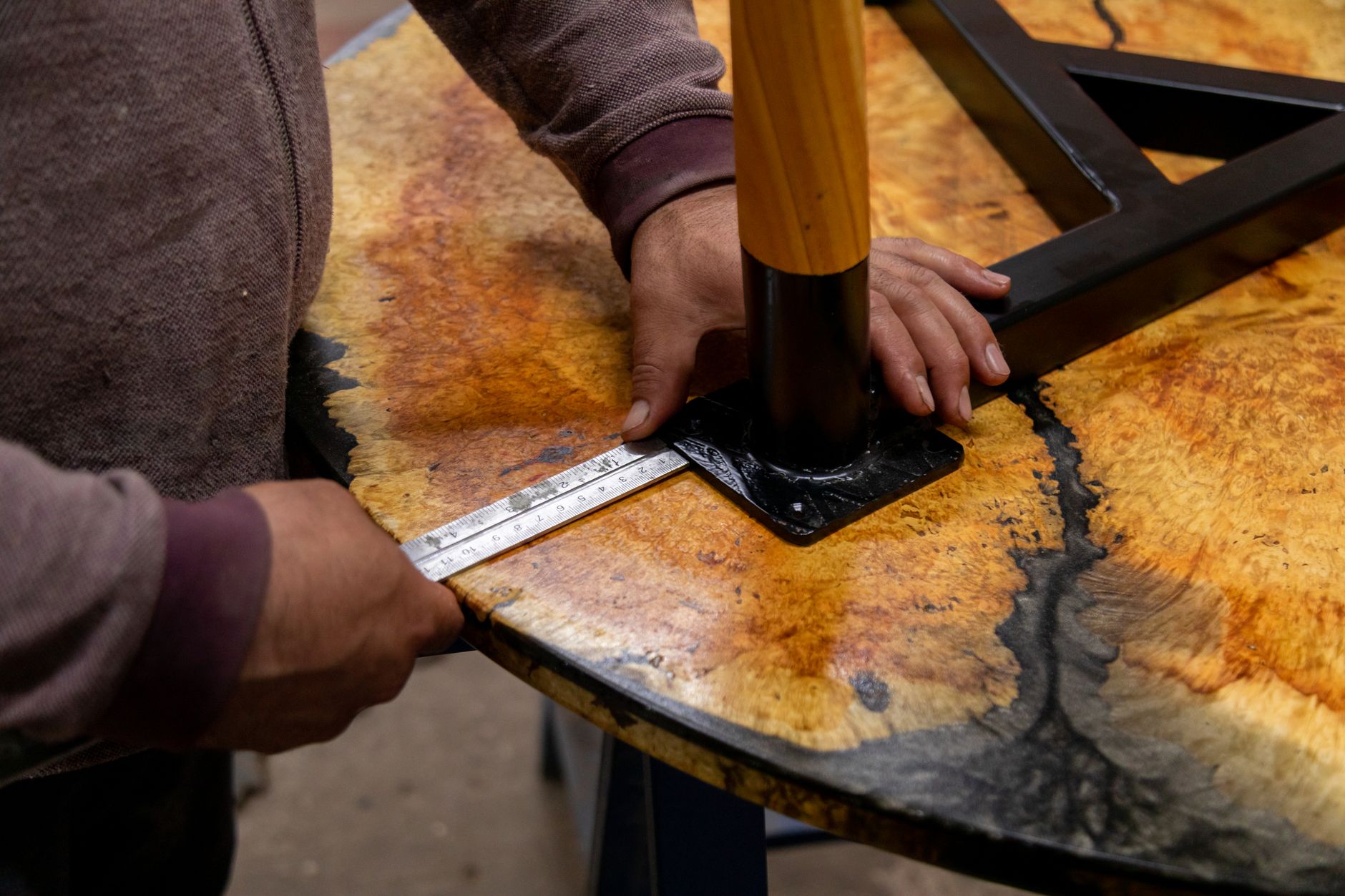
Figured woods — burls, crotches, quilted maple — are structurally unsuitable for solid construction because the interlocked grain makes them prone to checking. As veneer, that same wild grain becomes a canvas. The craftsman can quarter-match four leaves cut consecutively from the same flitch, creating a symmetrical, almost kaleidoscopic pattern across a drawer front. This is design work requiring both an eye for grain and an intimate knowledge of how a given species will behave under glue and pressure.
The 18th-Century Ébéniste and the Grammar of the Surface
In France, the craftsmen who worked in veneered furniture were called ébénistes — a word derived from ébène, or ebony, which was among the first exotic veneers to arrive in Europe. They were a distinct guild from the menuisiers, who worked in solid carved wood. This was not a trivial distinction. The ébéniste's workshop was organized around different tools, different adhesives, different sequences of work, and a fundamentally different relationship to material.
The great 18th-century ébénistes — figures like Jean-François Oeben, Jean-Henri Riesener, and Roger Vandercruse Lacroix — worked under the guild system of the ancien régime in Paris, which enforced strict specialties. A piece of furniture that combined veneered case work with gilt bronze mounts and upholstered panels might involve three or four separate guild members, each contributing their portion. The ébéniste was responsible for the carcass and surface, and that surface was understood as the primary expressive vehicle of the piece.
The dominant surface treatment of the Louis XV and Louis XVI periods was parquetry and marquetry. Parquetry uses geometric shapes cut from contrasting veneers to create repeating patterns — cubes, lozenges, basketweave — across a surface. Dressers and chests of this period often used parquetry across broad drawer fronts, where the geometric pattern both unified the composition and drew attention to the furniture's sculptural curves.
Marquetry: Picture-Making in Wood
Marquetry goes further than parquetry. Where parquetry is pattern, marquetry is image — flowers, birds, landscapes, trophies, urns, even architectural vistas, all assembled from hundreds or thousands of precisely cut wood fragments. The technique demands that the maker think simultaneously as a draftsman, a colorist, and an engineer.
The classical method involves drawing the design onto paper, then using a fine-toothed marquetry saw — historically a fret saw held in a frame — to cut the shapes from veneers stacked in a sandwich. Because multiple layers are cut simultaneously, the piece cut from one veneer fits precisely into the void left in another. This is called the pad method or the packet method, and it is what allows the extraordinary intricacy of a Riesener floral panel or a Gallé botanical composition to hold together without visible gaps.
Color in marquetry comes from the natural tones of different wood species — the warm gold of satinwood, the cool gray-brown of holly, the deep reddish-brown of rosewood, the near-black of ebony — but also from deliberate manipulation. Craftsmen used sand scorching, in which a fragment of veneer is briefly pressed into hot sand, to create gradients of brown that suggest shadow, depth, and three-dimensionality in a flower petal or a ribbon. This is not painting. It is a permanent alteration of the wood's surface achieved through controlled burning, and it requires practice to know exactly how long to hold a given species in the sand before it darkens too far.
Lacquer: The Language Borrowed From Asia
Alongside marquetry, European furniture makers of the 18th century became obsessed with Asian lacquerwork. Genuine Chinese and Japanese lacquer — urushi — is a painstaking process involving the sap of the lacquer tree, applied in many thin coats over months, each layer cured in controlled humidity before the next is applied. The resulting surface is extraordinarily hard, deep, and luminous in a way that no paint or varnish can replicate.
Genuine lacquer panels were imported from China and Japan and incorporated directly into European furniture — a practice known as japanning when imitated with European materials, and as lacquer furniture when the original Asian panels were cut and remounted onto European carcasses. The latter practice involved considerable violence to the original objects, but it produced pieces of startling visual power, where dense black grounds populated with gold figures in landscapes became the entire visual world of a cabinet door or a secretary fall.
European craftsmen who attempted to replicate the effect — japanning — used shellac-based varnishes, gesso grounds, and oil gilding. The results were beautiful but different: warmer, less dimensionally deep, and less durable than true urushi. The distinction mattered to connoisseurs of the time, and it still matters to restorers today, because the two materials respond to aging and damage in entirely different ways.
Art Nouveau and the Liberation of the Surface
By the 1890s, the grammar established in the 18th century was still being used — but a new generation of furniture makers began to push it in directions the ancien régime workshops would not have recognized.
Émile Gallé, working in Nancy, is the figure whose name is most inseparable from Art Nouveau furniture. Gallé was trained as a glass artist and came to furniture relatively late, but he brought to it an understanding of surface and depth that was entirely his own. His marquetry work combined species selected not only for color but for grain character — using the natural wildness of a figured wood to suggest turbulent water, mist, or the texture of a moth's wing. Where 18th-century marquetry tends toward the controlled and the symmetrical, Gallé's work is asymmetrical, biomorphic, and deliberately illusionistic.
Gallé also introduced inlays of materials beyond wood veneer — mother-of-pearl, glass, horn, and metal — into his marquetry compositions. This broke with the guild-era separation of materials and demanded that a single piece negotiate the very different behaviors of organic and inorganic materials under the same adhesive and atmospheric conditions. A panel that includes both thin veneer and a fragment of iridescent shell must be built with an understanding of how each material moves — or doesn't — with changes in temperature and humidity.
Louis Majorelle, also based in Nancy, took a different approach. Where Gallé's surfaces are painterly, Majorelle's tend toward the architectural. His marquetry designs use bold, sinuous lines — water lilies, orchids, wisteria — rendered in high-contrast veneers against dark grounds. His cabinets and storage pieces integrate the surface pattern with the bronze mounts that form the legs and handles, so that the carved or cast metal appears to grow from the wood rather than being applied to it. This integration of surface decoration with structural hardware is one of Art Nouveau's defining contributions to furniture design.
What These Techniques Actually Demand From a Maker
It is worth being specific about what the hands actually do, because this is where the difference between a historical technique and a modern reproduction becomes viscerally clear.
Cutting and fitting veneer
Veneer work begins with selecting and sequencing the leaves. A skilled veneer worker handles each leaf against the light, reading the grain, looking for the figure, deciding which face goes up and which goes down. The leaves are then jointed — their edges trimmed absolutely straight and flat with a veneer saw or a shooting board plane — so that adjacent pieces meet without a visible seam. This jointing is unforgiving: a gap of even a fraction of a millimeter becomes visible after finishing.
Adhesive and groundwork
Traditional veneer work uses hide glue — a protein-based adhesive made from animal collagen. Hide glue has a short open time (the window between application and when the glue begins to set), which means the craftsman must work quickly and confidently. It is also reversible with heat and moisture, which is why historic veneer can be lifted for repair centuries later. The substrate must be prepared precisely: any unevenness in the carcass telegraphs through the veneer surface after the glue dries and the wood acclimatizes.
Marquetry cutting
Fine marquetry cutting, particularly the floral and figural work of the Art Nouveau period, is among the most demanding small-scale woodworking tasks that exists. The saw blade — historically a thin jeweler's-style blade — must follow curves without tearing the fragile veneer. The craftsman works with the drawing as a guide but must anticipate how the cut piece will look once surrounded by adjacent colors and grains. A shape that reads correctly in isolation can appear wrong in context.
Sand scorching
Sand scorching requires a shallow tray of fine sand heated over a spirit lamp or hotplate. The craftsman holds the veneer fragment against the hot sand to darken it, checking constantly against the design. The wood species, the thickness, the moisture content of the piece, and the exact temperature of the sand all interact. There is no reliable timer; the craftsman reads the color change and removes the piece at the right moment. Over-scorched pieces are ruined.
Why the Surface Tells You What the Maker Knew
A piece of furniture's surface is, in a real sense, the record of every decision its maker made about material, sequence, and proportion. The grain direction of a background veneer tells you whether the maker understood how that species moves. The fit of a marquetry joint tells you how steady their saw hand was. The depth of color in a scorched petal tells you how well they understood heat and wood simultaneously. The integration of lacquer into a carved ground tells you whether they understood the dimensional limits of the lacquer film.
This is why looking closely at historical furniture — not just at photographs but at actual surfaces, ideally with a raking light that reveals every undulation and join — is one of the best educations in material intelligence available. The great makers of the 18th century and the Art Nouveau period were not decorators applying a finishing touch. They were building a language from the inside out, and the surface was always the argument.