In the 1860s, a group of British designers looked at the furniture pouring out of industrial factories and felt something close to moral revulsion. The problem wasn't simply that the pieces were ugly — though many were. The deeper offense was that they were dishonest. Veneers pretended to be solid wood. Machine-cut ornament mimicked the look of hand carving. Joints were hidden under filler and paint. The object lied about what it was and how it was made. Out of that revulsion grew the Arts and Crafts Movement, a philosophy of making that turned the humble chair, the cabinet, the table leg into statements of ethical intent — and whose influence on thoughtful furniture design has never really gone away.
The Industrial Problem the Movement Was Answering
To understand Arts and Crafts furniture, you have to understand what it was reacting against. The Great Exhibition of 1851 at London's Crystal Palace showcased the full spectacular excess of Victorian industrial production: furniture dripping with machine-stamped ornament, surfaces lacquered to disguise cheap timber, forms that referenced Greek columns, Gothic tracery, and Rococo scrollwork simultaneously, often on the same piece. There was technical virtuosity in some of it, but critics noticed something troubling: the relationship between a thing's appearance and its actual construction had been almost entirely severed.
John Ruskin, the art critic whose ideas provided much of the intellectual foundation for what followed, argued that this dishonesty in objects reflected — and reinforced — a deeper dishonesty in society. When workers were reduced to tending machines that stamped out decorative forms, they were denied the creative engagement that made labor meaningful. The object suffered, but so did the person who made it. Beauty, Ruskin insisted, was inseparable from the conditions under which something was made.

As an Amazon Associate, I earn from qualifying purchases.
William Morris and the Search for Purposeful Making
It was William Morris who translated Ruskin's cultural criticism into a practical program. Morris was a designer, poet, and committed socialist who founded Morris, Marshall, Faulkner & Co. in 1861 — later reorganized as Morris & Co. — with the explicit aim of producing objects that were both useful and beautiful, made by craftspeople who understood and took pride in every stage of their work.
The furniture that emerged from Morris's circle had a distinctly unshowy character. Early pieces designed by his collaborator Philip Webb were robust, rectilinear, and deliberately plain. Sussex chairs — a range of simple rush-seated chairs adapted from a traditional vernacular design — became emblematic of the approach: honest materials, visible construction, no pretense. These weren't aristocratic showpieces. They were objects that respected both the maker and the person who would use them every day.
Morris's famous dictum — "have nothing in your houses that you do not know to be useful or believe to be beautiful" — is often quoted as interior decoration advice. But read in context, it was a more radical statement: a call to interrogate every object in your environment for its integrity, its purpose, and the conditions of its production.
The Principles: What "Honest Construction" Actually Means
The Arts and Crafts Movement wasn't a single unified style so much as a set of overlapping principles. Understanding those principles explains both the look of the furniture and why it continues to resonate.
Truth to Materials
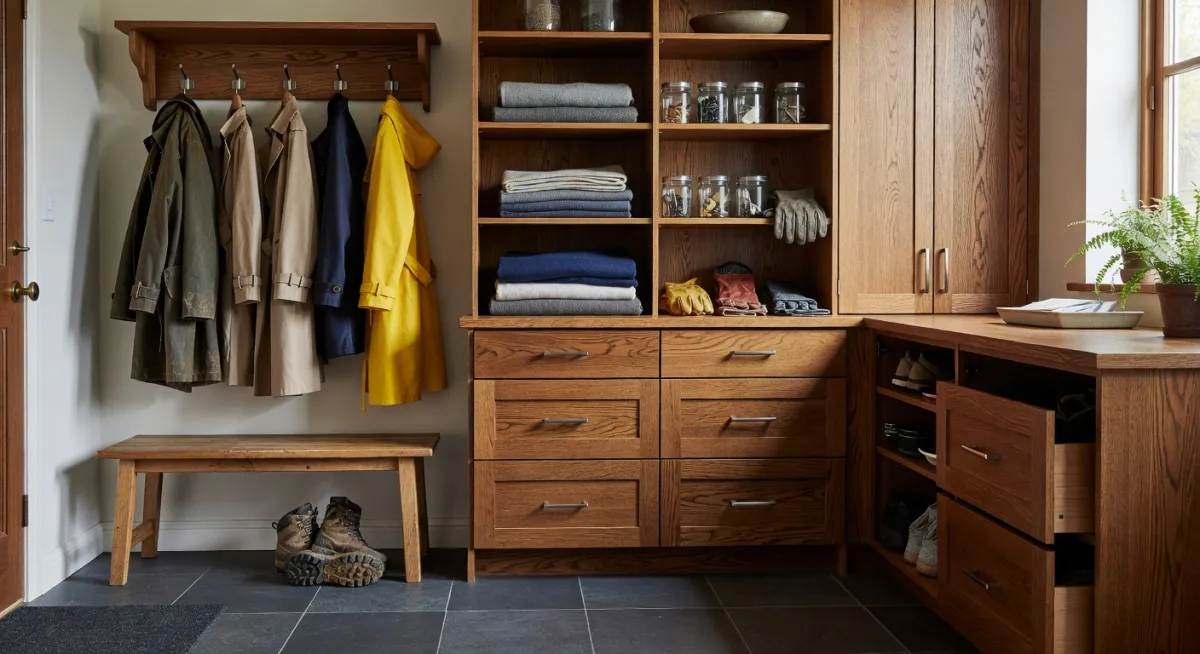
Arts and Crafts designers believed that each material had inherent qualities that should be expressed rather than disguised. Oak was the wood of choice for many makers — its open grain, its durability, its responsiveness to hand tools. To paint over oak, or to use a thin veneer of it over cheap softwood, was a kind of deception. The wood should be what it appeared to be. Surfaces were typically finished with oils or wax that enhanced the grain rather than obscuring it.
This principle extended to metal hardware. Hinges, handles, and escutcheons were often made from hand-hammered copper or iron, left with visible tool marks that testified to the hand that shaped them. The slight irregularities were features, not flaws.
Visible Joinery as Decoration
Perhaps the most immediately recognizable characteristic of Arts and Crafts furniture is the way structural joints are brought to the surface and treated as visual elements. The through-tenon — where a mortise-and-tenon joint is cut so that the tenon projects slightly through the outer face of the wood — became almost a signature. So did the exposed dovetail, the pegged joint, the keyed tenon.
This wasn't purely aesthetic. It was a demonstration of structural logic. You could look at a piece and understand, more or less, how it held together. The joinery was the ornament, and it earned its place by doing real work. When you see an armchair today with exposed tenons at the arm joints or through-wedged stretchers, you're looking at a direct inheritance from this tradition.
Functional Ornament Only
Arts and Crafts designers weren't opposed to decoration — Morris himself was one of the great decorative designers in English history, creating wallpapers and textiles of extraordinary complexity. But they insisted that ornament earn its place. Applied decoration that served no structural purpose and that could only be produced by machine — the stamped acanthus leaves, the meaningless grooves routed along every edge — was rejected. Where ornament appeared, it typically referenced natural forms: stylized leaves, birds, flowering plants. And it was carved, inlaid, or worked by hand.
The Social Dimension: Who Made It and How
For the movement's founders, the ethics of production were inseparable from the ethics of the object. Morris believed that the medieval craftsman, working within a guild system with genuine mastery over a complete trade, produced better objects because he was engaged in meaningful work — and that industrial production had destroyed that relationship. The ideal was a workshop in which skilled makers understood every process from raw material to finished piece.
This ideal was never perfectly realized, and the movement's critics — including some within it — noted the irony that hand-crafted Arts and Crafts furniture was inevitably expensive, accessible mainly to the prosperous middle-class clients whose values it was meant to reform. But the critique of alienated production remains pointed even today.
The Movement Crosses the Atlantic: Gustav Stickley and American Craftsman Style
The Arts and Crafts philosophy traveled to the United States in the 1890s and found fertile ground, particularly in the work of Gustav Stickley. Stickley visited England, absorbed the movement's principles, and returned to develop what he called Craftsman furniture — a distinctly American interpretation that leaned even more heavily into structural simplicity and the intrinsic beauty of quartersawn white oak.
Quartersawing — cutting the log radially rather than tangentially — produces boards with a characteristic ray-fleck figure and superior dimensional stability. Stickley made a point of using it. The visible figure was evidence that the wood was what it appeared to be and that it had been thoughtfully selected. His chairs and benches featured the exposed through-tenon joints, the pegged construction, and the plain rectilinear forms that the English movement had established, but with a frontier solidity that felt entirely American.
Stickley published The Craftsman magazine from 1901, spreading not just furniture designs but the complete philosophy: house plans, garden layouts, the idea of an integrated domestic environment built around honest materials and purposeful making. At its peak, the magazine had a substantial national circulation and helped define an entire approach to American domestic life.
Greene and Greene: Where Craft Became Poetry
While Stickley developed Arts and Crafts into a democratic, reproducible style, the California architects Charles and Henry Greene pushed it toward something rarer. Their Gamble House in Pasadena, completed in 1908, is one of the most fully realized Arts and Crafts environments ever built, with furniture, fittings, and architecture designed as a single integrated whole.
The Greene brothers took the through-tenon joint and refined it into something almost delicate — rounded, slightly proud of the surface, fitted with a small ebony peg. Their joinery was structurally sound and visually exquisite. They incorporated different species of wood in deliberate combinations, used art glass, hand-hammered metal, and hand-embroidered textiles to create interiors of extraordinary coherence. The "honest construction" principle had not been abandoned; it had been elevated into art.
Why These Principles Still Shape Thoughtful Design
The Arts and Crafts Movement as a historical episode peaked roughly between 1880 and 1920. But its principles didn't disappear — they went underground, resurfaced in the studio furniture movement of the mid-twentieth century, influenced Scandinavian modernism's emphasis on natural materials and honest construction, and continue to animate a significant strand of contemporary furniture making.
The Studio Furniture Movement
Beginning in the 1950s and accelerating through the 1960s and 70s, a generation of American furniture makers — among them Sam Maloof, James Krenov, and Wharton Esherick — developed a tradition of artist-made furniture that drew directly on Arts and Crafts values. Maloof's rocking chairs, with their carved connections between seat, leg, and rocker that flowed as continuous sculptural forms, were structurally innovative precisely because he understood his joinery deeply enough to reinvent it. Krenov wrote and taught extensively about the relationship between maker, material, and tool — a conversation that would have been entirely recognizable to Morris.
What Contemporary Makers Took Forward
Today's furniture makers who work in what might loosely be called the Arts and Crafts tradition share several recognizable habits of thought. They select wood for its specific character — the way the grain runs through a particular board, the color variation in a slab — rather than treating timber as a generic commodity. They show their joints. They finish surfaces in ways that reveal rather than obscure. And many of them think seriously about the conditions of their own labor: small workshops, direct relationships with clients, work that can be done with genuine engagement at every stage.
The principles also inform how informed buyers think about furniture. The question "how is this held together?" — which would have been perfectly natural before industrial production made it seem naive — has become a meaningful quality indicator again. Exposed dovetails, through-tenons, pegged mortise-and-tenon joints: these are no longer just historical references. They are evidence of a decision to make something that tells the truth about itself.
Reading Furniture with Arts and Crafts Eyes
One practical legacy of the movement is a vocabulary for evaluating furniture that goes beyond surface finish and style. If you find yourself in front of a piece and want to apply something like Arts and Crafts reasoning, a few questions are useful.
Does the structure express itself?
Can you read how the piece holds together? Are the joints visible, or is everything concealed under filler and finish? A cabinet where the case construction is evident — where you can see the dovetailed corners, the mortised frame — is making a different kind of claim than one where every joint is hidden.
Is the material honest?
Solid wood behaves differently from veneered engineered board, and neither is inherently dishonest — but the Arts and Crafts tradition would insist that each material be used in a way that acknowledges its nature. A thick veneer of beautiful figured wood over a stable engineered core can be entirely appropriate; a thin printed film that mimics wood grain while offering none of its properties is the kind of imitation the movement was founded to oppose.
Does the ornament earn its place?
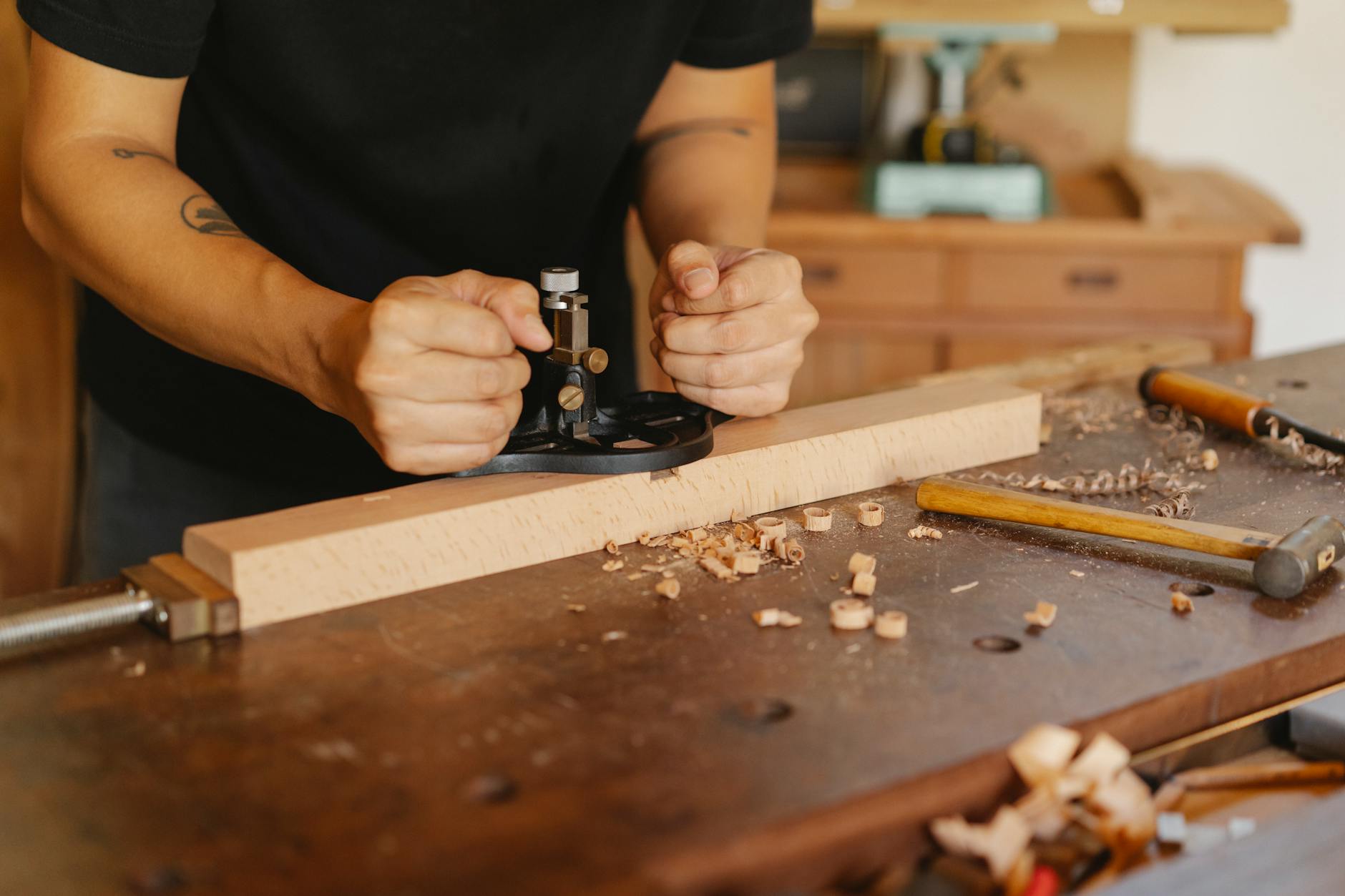
Detail that results from the construction process — the slightly proud face of a through-tenon, the pattern of a hand-cut dovetail, the texture of hand-planed wood — has an integrity that applied ornament can lack. This doesn't mean all applied decoration is illegitimate, but it's worth asking whether a decorative element is there because it means something or simply because it fills space.
The Moral Dimension: Is It Still Relevant?
The Arts and Crafts Movement was always as much about social criticism as aesthetics, and that dimension retains its edge. The questions Morris raised — about what it means to make things by hand, about the relationship between the conditions of production and the quality of the product, about whether we should know something about how the objects in our lives were made — are if anything more pressing in an era of globally distributed manufacturing, where the provenance of materials and the conditions of labor are genuinely difficult to trace.
You don't have to share all of Morris's politics to find the core insight useful: that objects carry the trace of how they were made, and that this matters. A piece of furniture built by someone with genuine mastery over their craft, from materials chosen with care, in a way that expresses rather than conceals its construction, is a different kind of thing in the world than one that is not. The Arts and Crafts Movement didn't invent this idea — every serious craft tradition in history has known it. But it articulated it with unusual clarity at a moment when industrial production was making it seem obsolete, and in doing so gave later generations a language to keep the conversation going.
That conversation — about honesty, materiality, and the ethics of making — is one the best furniture designers are still having. Every time a maker leaves a joint visible, chooses a finish that shows the wood rather than hiding it, or refuses to apply ornament that serves no structural purpose, they're participating in a tradition that began with a group of Victorian designers who looked at a factory chair and decided it was not good enough, for reasons that went all the way down.