There is a moment, easy to overlook, when a new technology stops pretending to be the old one. For the electric light fixture, that moment took decades — and the journey from gas-lamp imitation to genuine design object tells you almost everything you need to know about why fixtures look the way they do, and what any given one is actually trying to accomplish in a room.
The Gas Lamp as the Original Logic
To understand electric fixture design, you have to start with the object it was replacing. The gas lamp had a clear, honest logic: a burner produced an open flame, which was fragile and directional, so you surrounded it with a glass shade to protect it from drafts and diffuse its glow. That shade was typically globe-shaped or tulip-shaped — not for aesthetic reasons, but because those forms enclosed the flame most efficiently. Mounting arms were heavy and branched, because gas pipes had to run through them. Wall brackets angled outward to keep the flame away from surfaces. Every element of the gas fixture was a direct response to a physical constraint.
This is worth sitting with: the gas lamp was legible. You could look at one and understand exactly why it was shaped the way it was. That legibility — form following combustion logic — is what the earliest electric fixtures inherited wholesale, even when it no longer made sense.
As an Amazon Associate, I earn from qualifying purchases.
The Copycat Phase: Electric Light in Gas Lamp Clothing
When Thomas Edison's incandescent bulb became commercially viable in the early 1880s, manufacturers faced an immediate problem of familiarity. Consumers trusted the gas lamp. They knew how to read it, where to put it, and what a room lit by it felt like. The solution was straightforward and commercially sensible: make the electric fixture look like a gas fixture.
Early electric chandeliers kept the branching arms, the upward-pointing sockets, and the tulip glass shades — all of which had been designed around the behavior of flame. The bulb, of course, did not behave like a flame. It did not flicker, it did not need protection from drafts, and it produced light from a sealed glass envelope rather than an open point of combustion. The shades were now doing something different — they were softening and directing electric light rather than shielding fire — but they looked exactly the same.
This phase produced fixtures that were, in a strict functional sense, slightly absurd: heavy cast-iron or brass armatures that existed to route gas pipes, now routing thin electrical wire instead. The elaborate branching structures were engineering solutions to a problem the electric bulb had already eliminated. And yet they endured, because the visual language of "this is a light fixture" was still being established in the public mind.
The First Honest Response: Arts and Crafts and Art Nouveau
The first design movements to seriously engage with electric light on its own terms arrived around the turn of the twentieth century. Arts and Crafts designers, reacting against industrialisation, were paradoxically well-positioned to think freshly about the electric fixture: they were already committed to the idea that form should express material and process honestly. If electricity was the material, the fixture should express electricity's qualities — clean, invisible, controllable.
As an Amazon Associate, we earn from qualifying purchases.
Art Nouveau went further by treating the fixture as an opportunity for organic, flowing form that gas lamps had never quite permitted. Designers such as Louis Comfort Tiffany in America and Émile Gallé in France made the shade itself the primary object — not a protective enclosure around a flame, but a composition of coloured glass that transformed electric light into something closer to filtered sunlight. The fixture became, for the first time, a vehicle for light rather than a container for fire. This is a conceptual shift that still underlies how most decorative fixtures are designed today.
Modernism and the Exposed Bulb: A Political Act
If Art Nouveau celebrated the fixture as surface and ornament, the modernist movements of the 1920s and 1930s made the opposite argument. The Bauhaus school, in particular, treated the electric bulb itself as the honest unit of design. Hiding the source of light in layers of decorative glass and metalwork was, from this perspective, a kind of dishonesty — a bourgeois refusal to accept the beauty of industrial materials.
The result was a generation of fixtures that reduced themselves to near-nothing: bare bulbs on simple cords, metal reflector shades of the kind still found in factory and workshop settings, and pendant lamps that were nothing more than a functional hemisphere directing light downward. These were not minimal by accident — minimalism was a position, a claim about what light fixtures ought to be. The Bauhaus pendant lamp, with its clean geometry and absence of ornament, was making an argument about modernity itself.
This sensibility has never entirely gone away. The currently fashionable exposed-filament Edison bulb on a fabric cord is a direct descendant of Bauhaus logic, even when it is used in settings that are entirely decorative rather than industrial. The exposed source is still a statement: we are not hiding what this is.
Mid-Century: Light as Architecture
The postwar decades produced what is probably the most consequential shift in fixture design history: the move from the fixture as object to the fixture as architectural element. Mid-century designers — working in Scandinavia, Italy, and the United States — began to think about how light shaped space rather than simply illuminated it.
Poul Henningsen's PH lamp series, developed in Denmark across several decades beginning in the late 1920s, is the clearest example. Henningsen designed a multi-layered shade system specifically to eliminate glare while ensuring that every surface of the shade itself was illuminated — no dark spots, no visible bulb from any angle. The logic was not about hiding or revealing the source; it was about controlling exactly where light went and what it did to the surfaces around it. The fixture was, in effect, a piece of optical engineering dressed as a lamp.
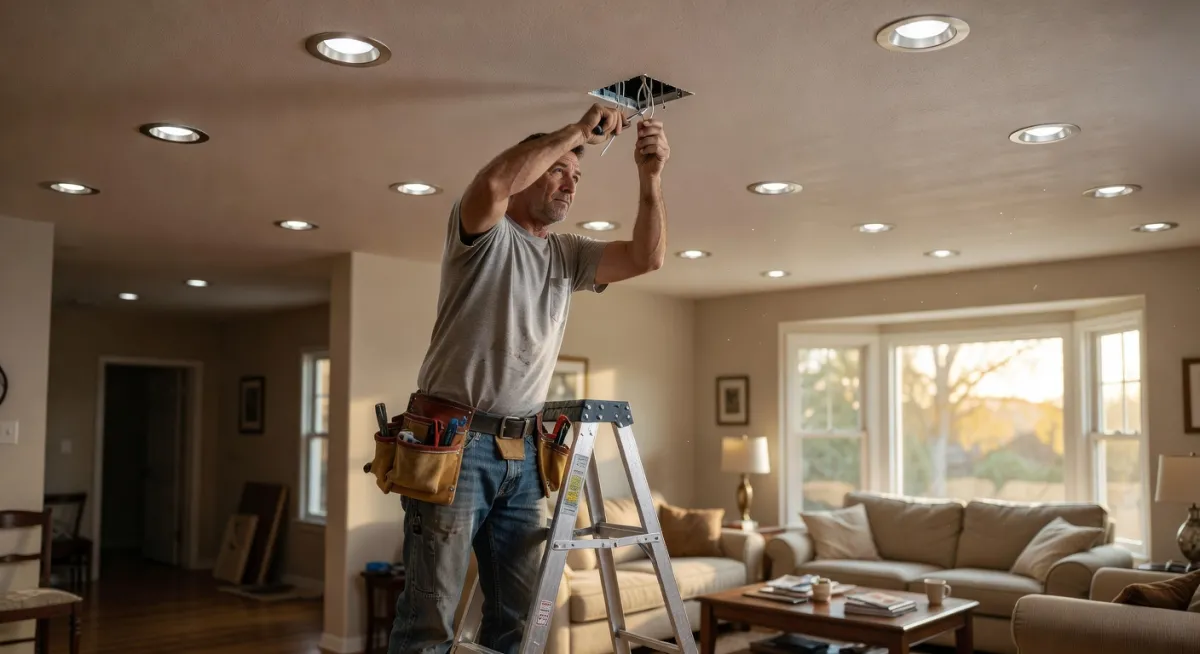
This period also produced the recessed downlight and the track light — fixtures specifically designed to disappear into architecture rather than assert themselves as objects. The recessed can light, which became dominant in American residential design from the 1960s onward, represents the logical extreme of the anti-fixture position: the ideal light source is one you cannot see at all, only its effect.
The Chandelier Reinvented: When Fixtures Became Sculpture
Running parallel to the minimalist and architectural traditions was a persistent counter-impulse: the fixture as statement object, descended from the grand chandeliers of pre-electric interiors but now freed from the constraints of candlepower and flammable materials.
Without the need to accommodate candles or gas jets, designers could build chandeliers in any direction, at any scale, from almost any material. Mid-century Italian designers explored Murano glass in forms that would have been impossible in gas-lit interiors. By the late twentieth century, designers such as Ingo Maurer were making fixtures from paper, feathers, broken crockery, and printed circuit boards — objects that happened to produce light but whose primary purpose was clearly visual and conceptual.
This tradition reaches its current expression in the statement pendant and the designer chandelier, both of which function less as lighting instruments and more as the room's focal point — the contemporary equivalent of a large painting or a piece of sculpture. Understanding this helps explain why such fixtures are often, deliberately, not particularly good at illuminating a room. That is not their job. Their job is to be looked at, and to give the room a center of visual gravity. Pairing a dramatic pendant with considered wall art and mirrors completes this visual logic — both are objects you look at, and both shape how light moves through the space.
What Different Fixture Types Are Actually Doing
Understanding this history gives you a practical tool for reading any fixture you encounter. Most fixtures are, consciously or not, operating within one of a few inherited traditions — and knowing which tradition tells you what the fixture is designed to do.
The Shade Fixture: Controlling the Field
Table lamps, floor lamps, and pendant lamps with fabric or glass shades are direct descendants of the gas-lamp logic of diffusion. The shade is softening the source, spreading light into a cone or sphere, and usually warming its colour temperature in the process. These fixtures are designed to create pools of comfortable, livable light — they humanise a space rather than illuminate it uniformly. A living room with well-placed shade lamps will feel warmer and more intimate than the same room lit by recessed downlights at the same overall brightness, because pools of light signal enclosure and rest in a way that even illumination does not.
The Recessed and Track Light: Disappearing into Function
Recessed downlights and track-mounted spotlights belong to the architectural tradition — they are designed to be noticed only through their effect. They are directional instruments, good at washing walls, highlighting art, or creating visual contrast. Their weakness is that they tend to produce flat, even illumination that, at low intensity, can feel cold and institutional. They work best as part of a layered scheme, combined with table lamps or decorative pendants that add warmth and visual complexity.
The Statement Fixture: Object First, Light Source Second
Chandeliers, sculptural pendants, and oversized designer lamps are in the lineage of the Tiffany shade and the Murano chandelier. They exist primarily to be seen, to anchor a room, and to communicate something about aesthetic position. They are almost always placed over a table or in a double-height entry, where they can be appreciated from a distance. The light they produce is usually ambient rather than task-specific, and often deliberately impractical — their scale or design means they are not optimised for illumination. Matching one of these fixtures to a considered dining table is a classic exercise in making two statement objects work in dialogue rather than competition.
The Industrial and Exposed-Source Fixture: Honest about the Technology
Bare-bulb pendants, factory-style reflector shades, and exposed-filament configurations are still working within the Bauhaus logic of honesty about materials. They say: here is the source of light, unadorned. In contemporary interiors this has become its own form of decoration — the exposure of the mechanism is now as much a style choice as the Tiffany shade ever was, which is a delicious irony the Bauhaus designers would probably have found troubling.
The LED Revolution: Another Copycat Phase, Another Reckoning
The shift from incandescent to LED lighting is producing a design inflection point that closely mirrors the gas-to-electric transition of the 1880s. Once again, an established visual language — the warm, globe-shaped filament bulb — is being replaced by a technology with a completely different physical form. Early LED fixtures mimicked incandescent bulbs almost exactly, producing the same globe shapes and filament appearances in solid-state technology. This is the copycat phase, and it is already giving way to something more interesting.
LED light sources can be made paper-thin, embedded in surfaces, bent into curves, and made to produce light from edges rather than points. Designers are beginning to build fixtures around these possibilities rather than against them — strips of light that define architectural edges, panels that glow as surfaces, and pendants where the shade and the source are the same object. The logic of the gas lamp — a point source requiring protection and diffusion — is becoming genuinely obsolete for the first time in modern interior history.
What comes next will likely be a new design language as distinct from the Edison-era chandelier as the Bauhaus pendant was from the gas-lamp sconce. We are probably in the early stages of it right now.
Reading a Room Through Its Fixtures
The practical payoff of understanding this history is the ability to read what any set of lighting fixtures is actually doing in a room — and to diagnose why a room that seems well-furnished still feels wrong.
A room lit exclusively by recessed downlights will feel flat and slightly clinical regardless of the quality of its furniture, because it has no pools, no contrast, no hierarchy of brightness. A room with only a single dramatic pendant will feel visually exciting but practically difficult to inhabit for long — you will be constantly aware of the glare or the darkness at the edges. A room that layers recessed ambient light, directional task light, and decorative accent fixtures is doing what the best interior lighting has always done: making light itself visible as a material, with texture and variation, rather than treating it as a neutral utility.
The fixture, understood this way, is never just a device for turning electricity into illumination. It is a designed object carrying a position on what light should do, inherited from over a century of argument between designers about honesty, ornament, function, and beauty. Knowing that argument makes you a more informed reader of the rooms you move through — and a more deliberate maker of the ones you design.